



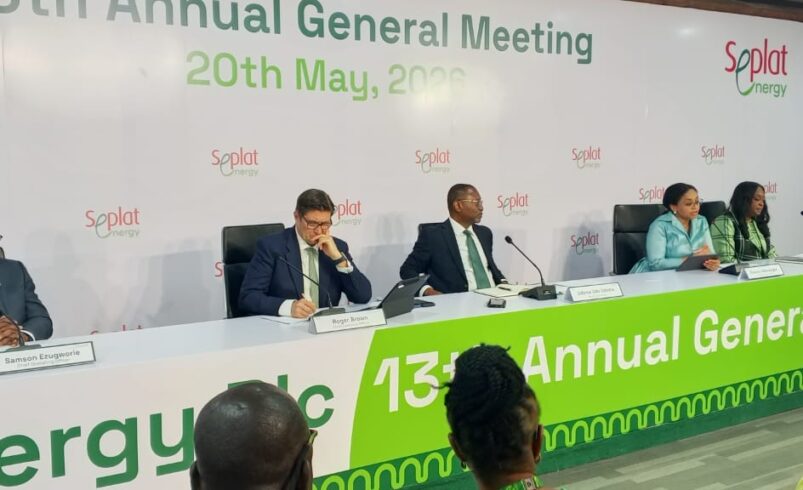
Seplat Energy has projected that it will deliver $1 billion in shareholder dividends over the next four to five years, as the indigenous energy company seeks to sustain investor returns following the integration of Mobil Producing Nigeria Unlimited assets.
The company also said it is targeting 500,000 barrels of oil per day in joint venture production while working towards tripling its attributable production over the medium term.
Chairman of the company, Udoma Udo Udoma, disclosed this during a post-Annual General Meeting media briefing in Lagos on Wednesday, where he said the company remained on track to meet both its production and shareholder return targets.
“We have committed ourselves to deliver a billion U.S. dollars in terms of dividends over the next four or five years. And we’re well on track.” he said. The dividend projection comes as Seplat continues to consolidate gains from its acquisition and integration of Mobil Producing Nigeria Unlimited, now renamed Seplat Energy Producing Nigeria Unlimited. The chairman said the company had completed both the acquisition and operational integration within timelines earlier communicated to shareholders.
According to him, the company has now moved into a single headquarters in Lagos after giving up its former office space as part of efforts to reduce operating costs and improve returns to shareholders. “Our commitment is to return shareholder value. So we’re always looking at ways of keeping our costs down and keeping our profits up,” Udoma said.
Also speaking, Chief Executive Officer of Seplat Energy, Roger Brown, said the integration had significantly expanded the company’s operational scale and strengthened its balance sheet. He said the combined business now comprises 11 oil blocks, including seven onshore and four offshore assets, with 48 producing fields and five gas plants.
Brown added that the company currently holds 1,001 MILLION BOE (APPROXIMATELY 1.0 BILLION BARRELS) IN 2P RESERVES, split evenly between oil and gas, while combined reserves and contingent resources stand at about 2.5 billion barrels.
“What the integration brings us is scale. We are a much bigger, more robust company.”
The company also outlined an ambitious medium-term production target of 200,000 barrels of oil per day attributable production and 500,000 barrels per day at joint venture level.
Chief Operating Officer, Samson Ezugworie, said Seplat had already set a production guidance of between 125,000 and 155,000 barrels per day for 2026 as part of its pathway towards achieving the longer-term target. He stated that operational priorities remained centred on safety, asset integrity and sustainable production growth.
According to him, the company had recorded “zero fatalities and zero lost time injuries” since the completion of the combined business integration.
On operational efficiency, Ezugworie said Seplat ended routine gas flaring in its onshore operations by the end of 2025, in line with earlier commitments made by management.
The company also said it restored about 50 idle wells in 2025 and plans to reactivate another 48 wells this year as part of efforts to increase production at relatively lower costs.
In addition, Seplat said pipeline losses across its operations declined to 3.8 per cent in the first half of 2025 following improved collaboration with the Federal Government and security agencies.
Management further disclosed that the company maintained over 99 per cent Nigerian workforce participation and continued to invest in graduate recruitment, local vendor development, healthcare and education initiatives across host communities.
Earlier at the AGM, shareholders also approved the appointment of Tony Elumelu as a Non-Executive Director and Larry Ettah as an Independent Non-Executive Director. They expressed optimism that time board changes would add value to the company.















Leave a comment