



FACTFILE with Lanre Alfred
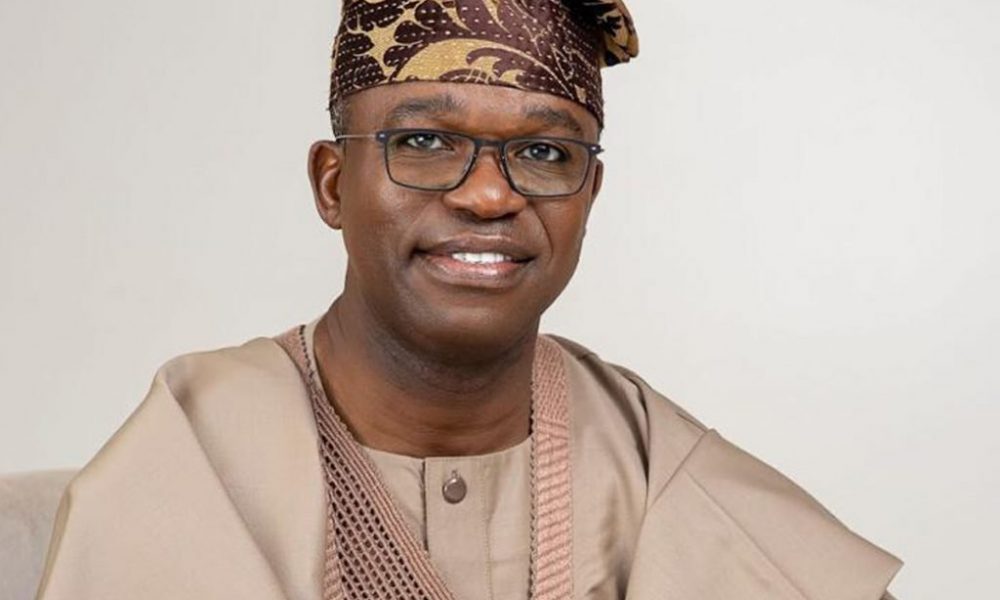
Some politicians dominate rooms, and some steady them. Senator Tokunbo Abiru belongs firmly to the second category, and in a political culture addicted to volume, that alone makes him an anomaly worth pausing over. He does not arrive trailing spectacle or grievance. He arrives with files, figures, and an unshakeable preference for order. Over time, that preference has matured into something rarer than charisma: credibility.
What draws attention to Abiru is not the theatre of ambition but the calm persistence of consequence. In an environment where public life is often reduced to viral moments and performative outrage, he has chosen a different grammar of power—one that privileges structure over spontaneity and results over rhetoric. This has made him formidable. His work resists easy summarisation because it is cumulative, unfolding across institutions rather than headlines.
Within Lagos East, his presence is felt less through slogans than through systems that hold. Cooperative societies that now understand discipline. Young people whose confidence has been shaped by exposure, not pity. Public interventions are designed to outlive applause rather than chase it. These are the quiet markers of a statesman who understands that leadership is not a mood but a method. Abiru does not promise transformation; he builds capacity for it.
What sets him apart from many of his peers is a studied refusal to confuse accessibility with populism. He listens without pandering, engages without posturing, and governs without the need to narrate every step of the journey. This restraint is often misread in a country that has learned to equate noise with care. Yet restraint, in Abiru’s case, has proven to be an ethic, a way of keeping institutions intact in a system that routinely personalises power.
There is also something quietly subversive about his record. It unsettles because it denies familiar excuses. It suggests that seriousness still has a place in Nigerian public life, and that progress does not always announce itself before it arrives. Abiru’s statesmanship forces an uncomfortable question: what if the work was always the point, not the performance?
This is why he is worth celebrating, not as a flawless figure, but as evidence that another style of leadership remains possible. Tokunbo Abiru stands as a reminder that endurance, discipline, and fidelity to process can still move societies forward. And perhaps that, more than any speech or spectacle, is what makes him quietly exceptional. This is worth recording in a book.
However, I didn’t set out to write a book about Senator Abiru. That is the part people may find hard to believe, especially those who imagine that books are often commissioned or birthed from ambition.
The truth is that I decided to write a book about him because I got tired of the lazy conversations. You know the ones. The cocktail chatter. The knowing smiles at private dinners. The half-informed cynicism that passes for political sophistication in Lagos’ upper rooms. “He’s quiet.” “Too technocratic.” “Not dramatic enough.” “Where is the noise?” In a society addicted to spectacle, restraint is often mistaken for absence. In a polity obsessed with shouting, discipline feels suspicious.
And yet, beneath the gossip, something else kept surfacing—results. Not the loud, chest-thumping kind. The uncomfortable kind. The kind that refuses to go away.
That was when I knew “The Economist as Statesman” was inevitable. The book, I must confess, is not wholly neutral. It does not pretend to hover above opinion. It is a deeply argued, unapologetically subjective case for why Tokunbo Abiru represents a type of statesmanship Nigeria talks about endlessly but rarely rewards. And why, in a season of performative leadership, that alone makes him worth writing about. This book is not propaganda. It is provocation. Yes!
Because what unsettles many people about Abiru is not what he has done, but how he has done it. No messianic posing. No populist theatre. No carefully choreographed outrage cycles. Just work. Quiet, structured, often boring work—the kind that doesn’t trend but lasts. And that, in high society Lagos, is dangerous.
We love our heroes flamboyant. We prefer our politicians to be either tragic or theatrical. We are far more comfortable with scandal than with steadiness. Abiru resists all of that. He does not leak. He does not posture. He does not over-explain himself to rooms that thrive on misunderstanding.
That restraint alone has made him a subject of speculation, and yes, envy. But envy is not why I wrote this book. I wrote it because I kept noticing how often Abiru’s name surfaced in moments of quiet repair. When institutions needed stabilising. When systems were fraying. When trust had to be rebuilt without applause. Polaris Bank became functional because he passed through it. Lagos State’s finances reliably held, on Abiru’s watch, amid anticipation of collapse. Lagos East subsequently became a place where programmes survived beyond launch ceremonies.
Those are not accidents. They are patterns. Society journalism, at its best, documents patterns alongside glamour; it interrogates power too. It asks who actually holds things together while others take bows. It peers behind curated narratives and asks who does the unglamorous lifting.
That is the Abiru story. And yes, let us talk about society, because Abiru’s life is deeply social, just not in the Instagram sense. He belongs to old Ikorodu. To Oriwu Club conversations that predate hashtags. To family tables where decisions are debated before they are announced. To a marriage that has survived ambition without becoming decorative.
His wife, Feyisola, is not an accessory to his public life; she is a parallel force. An entrepreneur who built a manufacturing business when such choices were unfashionable for “well-educated women.” A woman whose factory employs real people, whose furniture sits in real homes, whose excellence earned her global recognition without borrowed prestige.
Power couples in Lagos often perform romance. The Abirus practise alignment. That distinction matters. It matters because it explains the tone of Abiru’s politics. This is not a man performing masculinity or authority for applause. This is a man accustomed to being questioned at home, corrected privately, and supported without spectacle. That kind of domestic discipline bleeds into public conduct.
Now, let me address a crucial question: Why write a book now? Because silence, when prolonged, invites distortion. In the absence of narrative, noise fills the vacuum. And Lagos has never lacked noise. What it lacks is serious documentation of serious people who refuse to turn leadership into entertainment.
This book is a counterweight. It says: here is a man whose life refuses easy categorisation. Banker, yes, but not detached. Politician, yes, but not theatrical. Family man, absolutely, but not performative. Muslim, disciplined, private, consistent. These things do not trend, but they endure.
And endurance, in Nigerian public life, is radical. Let me be clear: the book does not canonise Abiru. It interrogates him. It examines his choices, his silences, his methods. It asks uncomfortable questions about restraint in an era that rewards excess. It challenges the reader to consider whether leadership must always announce itself to be effective.
Interrogation, in this sense, is not adversarial; it is rigorous. The book places Abiru’s decisions under light rather than spotlight, tracing not only what he did, but why he resisted doing other things that would have been easier, louder, and more immediately gratifying. It explores moments where spectacle was available to him and consciously declined, not out of timidity, but out of a disciplined belief that governance collapses when it becomes theatre. This refusal becomes a central line of inquiry: what does it mean to lead when you deliberately step away from applause?
The Economist as Statesman also probes his silences, which are perhaps more controversial than his actions. In Nigerian public life, silence is often read as guilt, weakness, or absence. Here, silence is treated as a strategic and moral choice. The narrative examines how Abiru deploys quiet not as evasion but as insulation—protecting processes from premature politicisation and shielding institutions from being personalised. It asks whether silence, when paired with outcomes, can itself be a language of leadership.
Equally examined are his methods, particularly his insistence on structure over spontaneity. The book dissects how his banking background shaped an almost instinctive preference for systems that self-correct, for rules that outlast personalities, and for programmes that scale without constant supervision. This methodical posture is not romanticised; it is tested against Nigeria’s impatience, its hunger for visible relief, and its deep distrust of delayed gratification. The analysis asks whether such an approach is sustainable in a society conditioned to distrust anything that does not immediately perform.
Most critically, the book confronts the discomfort this approach creates for observers. It asks the reader to wrestle with a difficult possibility: that effectiveness may not always look like passion, that seriousness may not always sound inspiring, and that impact may not always arrive wrapped in drama. In doing so, it does not ask the reader to admire Abiru blindly, but to reassess the metrics by which leadership itself is judged.
What unsettles some of Abiru’s critics is that his record forces comparison. Quiet men are inconvenient because they remove excuses. When someone achieves without noise, it exposes how much noise others have been hiding behind.
Comparison is destabilising because it strips away narrative protection. The presence of a figure who delivers without constant self-advertisement challenges the elaborate storytelling that props up underperformance elsewhere. It becomes harder to blame hostile environments, uncooperative systems, or impatient citizens when evidence exists that steady progress is possible without theatrical defiance. Abiru’s record does not accuse; it simply stands there, and that is often more threatening.
The discomfort deepens because quiet achievement disrupts the emotional economy of politics. Many actors rely on outrage, victimhood, or permanent agitation to justify stagnation. Abiru’s approach offers no such emotional currency. By refusing to dramatise obstacles, he denies critics the pleasure of shared grievance. This forces a reckoning: if progress can be incremental, disciplined, and largely uneventful, then what exactly has all the noise been for?
There is also a social dimension to this unease. In elite and political circles, visibility is often confused with relevance. Loudness becomes proof of importance. Abiru’s low-decibel presence unsettles this hierarchy. He occupies space without constantly asserting it, accumulates influence without performing it, and earns loyalty without demanding it. Such a posture quietly reorders the room, and not everyone benefits from that reordering.
Ultimately, the comparison Abiru’s record invites is not merely between individuals, but between philosophies of leadership. One treats governance as a stage; the other treats it as stewardship. One depends on continuous validation; the other depends on continuity. The book does not claim that one model will always prevail, but it insists that the second deserves serious attention. And it is precisely because that attention threatens established habits that the quiet man, doing his work without noise, becomes so profoundly inconvenient.
That is why this book has already generated murmurs in certain circles. Some people would prefer Abiru remain an abstraction, safe to dismiss and easy to underestimate. Documentation disrupts that comfort.
A written record does not shout, but it lingers. And let us not pretend this is only about Abiru. It is about the kind of public culture we are rewarding. About whether we want leaders who build systems or stars who burn brightly and disappear. About whether Lagos East—and Nigeria more broadly—has the patience for governance that looks dull until it saves you.
High society loves stories of collapse. We dine on downfall. We trade in whispered scandals. But occasionally, a different story insists on being told: the story of steadiness in a volatile environment.
That is what I have attempted with my narrative on Abiru.
















Leave a comment