



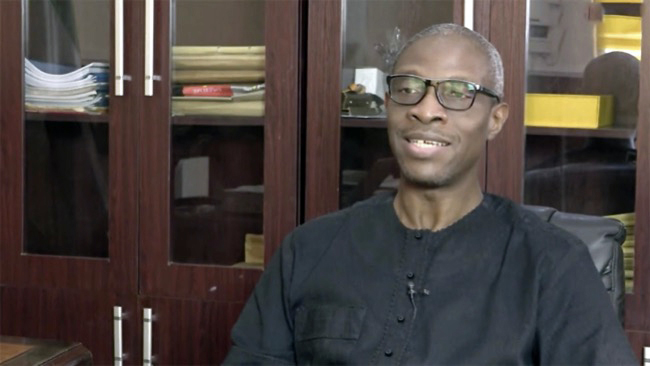

After three years at the helm of Association of Senior Staff of Banks Insurance and Financial Institutions (ASSBIFI), Oluwole Olusoji speaks with the calm of a man who has stepped out of the storm—but not away from the struggle. Now balancing his role within the Trade Union Congress (TUC), he describes his transition as “a bit lighter,” a rare breathing space that allows him to reflect not just on leadership, but on the deeper realities facing Nigerian workers. Yet beneath that calm lies a blunt assessment: progress has been made, but the country is still far from where it ought to be.
At the heart of his reflections is a widening gap between policy and lived reality. From minimum wage negotiations to tax reforms and government spending, Olusoji acknowledges intent but questions execution. “Nigerians are not getting a fair deal,” he says, pointing to a system where rising costs of living, security, healthcare, education, power have quietly eroded incomes, leaving even top earners stretched. For him, the real issue is not just wages, but the failure of public services that should make those wages meaningful.
Still, he sees pathways forward. Banking reforms, including recapitalisation, are holding steady without major job losses; for now, while technology and AI, though disruptive, present opportunities for those willing to adapt. But his warning is clear: the greatest threat to workers today is survival itself, driven by rising costs and systemic gaps. And unless leadership begins to “walk the path of the ordinary Nigerian,” he argues, the divide between promise and reality will only deepen.
Excerpt:
What does it feel like after being president of assbifi while still maintaining your position in TUC?
Well, it’s been a bit lighter if I’m permitted to say that. To say it, it’s been a bit of a breathing space for me too after three years of service as the national president. Probably now I have a little bit more time to do other things outside unionism. Other things, like personal, social, service to humanity in various forms.
What is the present position of TUC? How do you assess the overall condition of Nigerian workers today?
I can’t say we are where we ought to be. Things could be better. But I also believe that having a guided leadership like we have in the TUC, we’re gradually heading in the direction that we have to be. We know the crisis that happened during the minimum wage negotiations and coming to an agreement on what needed to be paid. But we also need to understand the fact that while TUC is seen as a leadership of the unions in Nigeria, we cannot deny the fact that Nigerians generally also look up to the unions for some kind of direction in how to deal or manage the situation with governance and of course the leadership of the country. So if I had to give a score, I would give us a pass mark so far. I believe that there is still room for improvement. But in fairness, I think we have done the best that we can to ensure stability while ensuring that people get a fair deal.
Where is that place we want to be from the standpoint of TUC?
We want a situation where people have easy access to their basic needs. Good health, good education, housing, efficient transport system, pay that is commensurate with the kind of work that they do so basically being adequately rewarded for their inputs in the development of the country.
How do you rate president bola Tinubu’s administration from the organised labour’s point of view? What are their strong points and lapses?
I must start to say that I believe that the leadership means well. But it’s one thing to mean well and it’s another thing to do well. There are a lot of sacrifices that have been made by Nigerians. There are a lot of changes that have not been very palatable which we expect should bring improvement. But what we find also is that we have people in positions of authority, people in positions of leadership who are not walking the talk and who are practically living off Nigerians. Let’s put it that way. They are practically living off Nigerians and they are not practicing what they expect the common Nigerian to practice.
For example, you find them leaving the country for health reasons, a country where they should have established good health facilities, you find them using excessive security personnel, but thankfully police security has been withdrawn. In a situation where you have not improved on security, you find their children going abroad to study, in a situation where you have not improved the quality of education that you have in Nigeria. And we can go on and on and on in those areas.
Do you believe there’s any recourse? What more can be done so that the dividends of democracy trickle down to the ordinary nigerian and not just the elite or leaders living off the nation?
I think they should practice more walking the path of the ordinary Nigerian. Because there are times when you walk that path, you are likely to do something to improve those areas, so to speak. Basically, that is it. If they do not experience what it is practically, then they will continue to have the same kind of problems that we have. Because all these things, let’s face reality, these things are achievable. I mean, if we look at some sectors of government, you’ll find things are working. So people are moving and ensuring that those changes occur.
A point in case, if we look at the Ministry of the Interior, under the Ministry of the Interior, we have the immigration, we see how passport services are improving. We see our airport services are improving. If we look at which ministry again now. I don’t have them off my head now. There are some areas where you find the changes occurring.
But of course, you’d also see the push back because some toes must have been stepped upon in ensuring that those things happen. So in reality, these things are doable. We have the resources. We have the people. We have everything that it takes to be able to achieve it. It’s just that group of people who are in charge in those areas to ensure that those things happen.
What is the progress of the ongoing banking recapitalisation? Has it protected jobs or are there silent job losses?
Well, so far, and I remember I said this in various forums when the announcement was made two years ago, that I believed that the way it was planned out, the way it was structured was much better than previous recapitalization exercises. Timelines were given, banks were supposed to come up with their plans and so far I think it’s been working out alright. And from the reports that we are seeing, most of the banks have actually met the recapitalisation, the ones that are going to merge have already announced their mergers.
We’re expecting where we’re expecting reports on a couple of others I think about three or four banks that we’re expecting reports on merging. The beauty of it is that it has been structured in a way that the banks can either choose to downgrade, upgrade, or remain where they are presently.
In terms of job security, so far there hasn’t been any major report. Let’s put it that way, no major report of any major job losses. But this is an exercise that ends in April. By April, we will know where we are headed. I think one of the things I mentioned at that time was that, I mean, if you are growing your capital by such a humongous amount, it means that you are expected also to do bigger business. And if you are going to do bigger business it means that we are likely going to need more people to be able to attract those businesses and manage them effectively.
How about roles that can be overtaken by ai? Do you think banks will take in more people or ai will do most of the job?
Yes, AI is a threat but AI can also be effectively used without necessarily meaning a job loss.
So what was the AI do, it enhances your job so there may be functions that AI will take over but there are also functions that what AI will do is to make you do multiple of what you were able to do manually by yourself. So the question is are people AI ready? Are they adequately equipped to be able to use AI to their advantage?
Today, every time that I go into a particular social media space or tech space or whatever, I find out that maybe of five advertisements, three of them are AI related. I’ve seen organizations that are training their staff using AI. So the question will be, by the time we get there, who are the people that are going to first be at risk? Likely the people who have not adapted to AI. However, it does not mean that there will not be threats to other functions. So, and let’s be clear about this. Because, okay, yes, we are discussing about banking, but truth of the matter is that it is the generality.
There are things that I ordinarily would have paid people to do, but I do with my phone today. But the issue would be, how quickly we can see and utilise the opportunities that exist rather than feel defeated.
How is organised labour prepared for these job losses?
One thing is certain from the organised labour perspective, right? We still feel that the government is putting the cart before the horse. You can’t just adapt to something without making adequate preparation. I said earlier on, I said the number of organizations are preparing their own workers for AI, training them. Now, they may be training them to enhance their work if for any reason, if for any reason there is a loss of job that person is also equipped adequately to use that same tool to their own advantage.
Let’s go back in history because when we talk of AI, you know every time a new thing happens we see it as a fresh start. When we moved from typewriters to electronic typewriters, then moved to computers. When computers came, what was said? “Typists were going to lose their jobs”, right?
But typists who knew what was good and helped themselves were able to fall into new roles. We suddenly found typists now becoming Pas, becoming executive assistants.
Why— they could use computers.
Let’s go back to our sector. We went from my manual bank where we were recording everything manually, computerization came.
There were job losses, but at the end of the day, bank branches increased. Then we moved on to online banking, to be able to do your transactions off your phone without having to step out. Again, the same thing, there will be job losses.
But what happened? Bigger opportunities were created. Because for you to be able to do internet banking, for example, it meant that somebody had to be developing something somewhere, somebody had to be reconciling, somebody had to be doing training somewhere. So opportunities will continue to occur and businesses will continue to grow faster. The question is how big is each individual for that change?
And when we look at it outside the banking sector, I look generally today, who are the people that are affected when I look around? The printers are affected. Today everybody has their letterhead, soft copy, they do it, they are able to put it in their signature. The question will be, what are printers thinking of doing right now to be able to move on to other things within their own space that will still make them marketable to their former clients so to speak and it cuts across almost every kind of business that we can think of today.








Leave a comment