



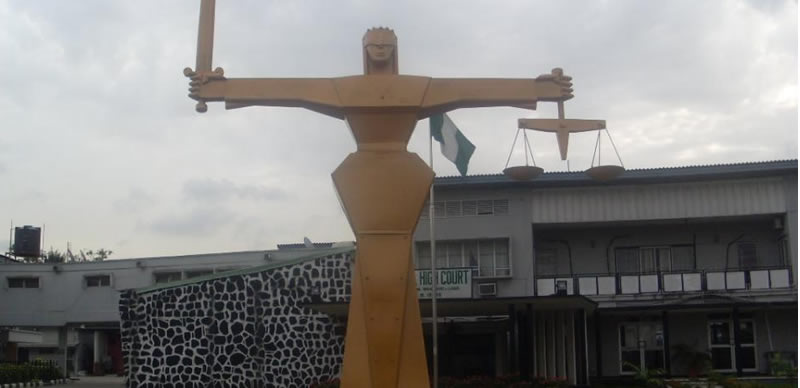

A Federal High Court sitting in Lagos, on Thursday, struck out a suit instituted by the Lagos State Internal Revenue Service against Eroton Exploration and Production Limited, following confirmation that the defendant had fully discharged its outstanding tax liabilities.
Delivering a ruling in the suit marked FHC/L/CS/2499/2025, Justice Akintayo Aluko held that the payment of the alleged debt had extinguished the plaintiff’s cause of action, thereby rendering the suit academic and stripping the court of jurisdiction to proceed further.
“The cause of action in this suit has been completely extinguished by the settlement of the outstanding tax liabilities.
“There is no longer any live dispute requiring the adjudication of this court,” the court held.
The court consequently struck out the suit and vacated all interim orders earlier granted, including those relating to the appointment of an administrator over Eroton, effectively bringing the administration process to an end.
When the matter came up on Thursday, Dr Joseph Nwobike (SAN), leading Victor Chukwumah and David Nwobike of Osborne Law Practice, announced appearance for Eroton and Bilton Energy Limited, while Jubril Kareem appeared for the LIRS.
Sesugh Famave, with Ogunwole Ebenezer and Kehinde Sanwade, appeared for the interim administrator, and Adesewa Mojeed represented an applicant seeking to be joined in the proceedings.
At the resumed hearing, counsel for the interim administrator urged the court to adjourn the matter pending the determination of a motion for joinder filed by the interested party, an application supported by counsel for the joinder applicant.
However, counsel for Eroton opposed the request, contending that it constituted an abuse of court process in light of the undisputed settlement of the alleged tax liability.
Drawing the court’s attention to an affidavit of settlement, accompanied by a letter from the Office of the Attorney-General of Lagos State, counsel submitted that the LIRS no longer had any subsisting claim against the defendant.
“The doctrine of mootness applies in the circumstances. The plaintiff’s cause of action has been extinguished, and this honourable court lacks jurisdiction to continue with the proceedings,” defence counsel argued.
The counsel further challenged the competence of the interim administrator’s participation, submitting that it fell outside the scope of the administration application and was therefore misconceived.
Relying on judicial authorities, including South Atlantic Petroleum Ltd v Minister of Petroleum Resources (2023), the defence urged the court to strike out the suit and discharge all subsisting interim orders.
In response, counsel for the LIRS confirmed the position of the tax authority, informing the court that the defendant had fully settled its obligations.
“We confirm that the outstanding liabilities have been paid. The plaintiff no longer has any claim against the defendant,” counsel to the LIRS stated.
In his ruling, Justice Aluko agreed with the submissions of the defence and held that the application for joinder was incompetent in the absence of a subsisting cause of action.
“Where there is no live issue between the parties, there is no basis upon which a third party can be joined.
“The application for joinder is therefore incompetent and liable to be refused,” Justice Aluko held.
The court further observed that the conflicting positions of the plaintiff, which sought to discontinue the suit, and the proposed co-plaintiff, which sought to sustain it, demonstrated the lack of common interest.
Justice Aluko also clarified the scope of administration proceedings under the Companies and Allied Matters Act, 2020.
“Administration under CAMA is designed as a rescue mechanism for financially distressed companies.
“It is not intended to serve as a tool for indiscriminate debt recovery, as it appears to have been pursued in this case,” the court held.
It accordingly struck out the suit and discharged all interim orders previously made.
Recall that in earlier proceedings, the court had granted interim reliefs restraining the enforcement of ex parte orders and barring the administrator from acting pending the determination of substantive applications.
The court also issued a mandatory restorative injunction nullifying steps already taken pursuant to the disputed orders, including administrative actions and communications arising from the administrator’s appointment.
Eroton had argued that the orders were obtained without full disclosure of material facts and that allowing them to stand would prejudice its right to fair hearing, as guaranteed under Section 36 of the Constitution.
Following the ruling, the court restored the parties to the status quo ante, effectively terminating the administration process and reversing all actions taken under the vacated orders.
















Leave a comment