



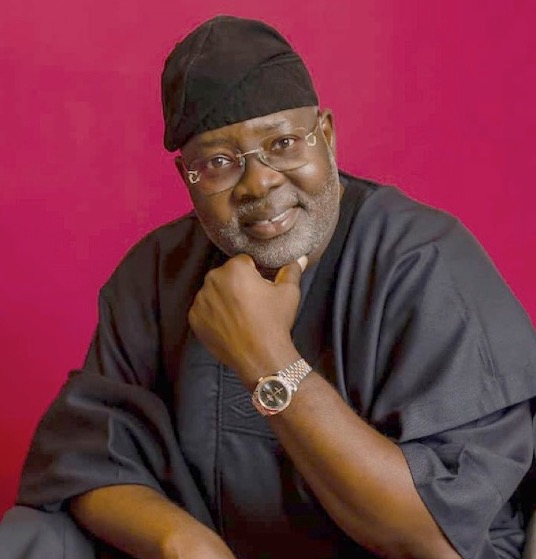
For more than three decades, Dayo Adedayo has documented Nigeria through his lens, capturing and preserving its memory. As CEO of Dayo Adedayo Photography, he presents the country not as noise or crisis, but as a complex, enduring nation that refuses to disappear. Adedayo Adejobi writes
High above Victoria Island’s skyline, where Lagos rises in glass, steel and restless ambition, Dayo Adedayo sits in an office suspended between memory and motion. Beyond the wide panes, the Atlantic glints with familiar arrogance. Eko Atlantic pushes defiantly into the sea. Traffic coils below like a living organism. Lagos is in perpetual rehearsal for tomorrow.
Inside, however, time slows.
The room is brightened just enough to quiet distraction. Professional cameras line one wall, not as ornaments but as instruments of duty. Adedayo himself is calm, observant, almost monastic in bearing. He speaks with the quiet certainty of a man who has already made peace with time.
“I have never been interested in noise,” he says evenly. “What matters to me is what lasts.”
For more than three decades, his camera has served as a witness. While trends rise and collapse under their own spectacle, Adedayo has been doing something far less fashionable and far more enduring: remembering a nation.
To call him simply a photographer feels reductive. He is an archivist of the Nigerian experience. A cultural anthropologist by instinct. A custodian of continuity in a country that reinvents itself at an alarming speed. Through his lens, Nigeria is not reduced to crisis or caricature. It is rendered whole, complex, layered and stubbornly alive.
“The ordinary is where truth lives,” he says. “If you lose that, you lose everything.”
Adedayo’s journey into photography was deliberate. In 2003, he formalised his training at Westminster College and later the University of Westminster in the United Kingdom. There, photography ceased to be a hobby or instinct; it became language, record, and evidence.
“Without training, I would not have survived this work,” he reflects. “Passion is not enough. You need discipline. You need context.”
When he returned home, what confronted him was not merely opportunity but absence. Nigeria, vast and culturally intricate, was poorly documented by its own people. Its images were often outsourced and narratives were framed externally.
“If you do not document yourself,” he says, “someone else will do it for you, and they will get it wrong.”
That realisation altered the trajectory of his life.
His first deliberate act as a national chronicler was photographing the National Assembly in Abuja.
“I wanted to start from the centre,” he explains. “Not because power is everything, but because history demands reference points.”
From there, he embarked on what can only be described as a monumental undertaking. Over the years, Adedayo has photographed all 774 local government areas in Nigeria. Landscapes and skylines. Rituals and routines. Markets, mosques, cathedrals, festivals, highways, forests, plateaus and forgotten villages.
“Nigeria is changing faster than we realise,” he says. “I am racing time, not chasing fame.”
His archive now runs into more than four million images — fragments of a present that is already slipping into memory.
Nowhere is his vision more transformative than in Lagos in Motion, his acclaimed visual study of Nigeria’s most misunderstood city.
Lagos is frequently described as chaotic, overwhelming, and unruly. Seen from the air through Adedayo’s lens, it becomes something else entirely — an organism of astonishing intelligence. Waterways thread through dense neighbourhoods with organic precision. Informal systems overlap inherited colonial grids. Vegetation asserts itself between concrete ambition.
“Lagos is not a disorder,” he insists. “It is intelligence without permission.”
What others call chaos, he sees as rhythm. A city that functions through instinct long before policy catches up. A metropolis governed by survival, ingenuity and invisible choreography.
The irony is impossible to ignore. As he speaks, the Lagos skyline continues its relentless transformation. Bar Beach has given way to Eko Atlantic’s audacity. Lekki, now shorthand for aspiration, barely registered on the city’s map a generation ago.
“In another decade, this will look completely different,” he says quietly. “People forget very quickly. Photographs do not.”
His images have already become evidence of what once was. Recognition, inevitably, followed devotion.
Today, Adedayo’s photographs appear on Nigerian passports and currency. They travel across borders, tucked into wallets and handbags, carried unknowingly by millions.
For him, this remains the highest honour. “It means the country has looked at itself and said yes,” he says. “That matters.”
Yet the applause does not animate him. His satisfaction lies elsewhere, in posterity. “I am working for people I will never meet,” he says. “That is the purest kind of responsibility.”
He imagines future generations asking what Nigeria looked like before shorelines shifted, before highways swallowed villages, before traditions thinned into performance. His archive exists for them.
“You cannot re-photograph yesterday,” he adds. “Once it is gone, it is gone forever.”
Such devotion is neither glamorous nor effortless. Financing nationwide documentation is a formidable undertaking. Logistics alone require vast resources — equipment, travel, time. Since 2003, he has driven across Nigeria’s terrain without a single accident, often sleeping on highways, trusting instinct and providence.
“I have been protected,” he says simply.
When he lists the places he has documented — Sungbo Eredo, Obudu, Mambilla, Yankari, Awhum, Ogbunike — the inventory feels less like conquest and more like gratitude. He has witnessed Nigeria in extremes: deserts and rainstorms, caves and waterfalls, cold plateaus and sunburnt plains.
“Nature is innocent,” he says. “It is people who complicate things.”
Despite the scale of his work, he insists he has never “worked” a day in his life. Photography, he maintains, has been a joy. Sunrises that spill gold over forgotten hills. Villages waking before dawn. Rivers folding into mist.
For a man who has archived millions of images, he speaks often of peace.
“If you have peace,” he says, “you are already rich.”
Adedayo’s optimism about Nigeria’s potential is tempered by realism. Tourism, he argues, remains underfunded. Cultural institutions lack resources. A country overflowing with festivals, architecture, fashion, cuisine and oral histories has yet to fully curate its own magnificence.
“We are sitting on gold and arguing about dust,” he says.
Until Nigerians recognise their own beauty, he believes, economic transformation will remain partial.
Education is his recurring refrain. Photography, like nation-building, requires ethics, context and structure. He is increasingly committed to knowledge transfer, determined that the next generation of visual storytellers should be better equipped and more protected.
“If I keep this knowledge to myself,” he says, “then I have failed.”
Beyond the public figure is a private man guided by conviction rather than spectacle. He speaks of marriage as friendship anchored in communication and shared values. Of faith as conscience more than performance. Of visibility as distraction.
“I prefer substance,” he says. “The rest is noise.”
In an era obsessed with virality, he remains intentionally off the radar.
As afternoon light tilts across Victoria Island, the skyline outside his window glows briefly before softening. Lagos continues its ceaseless becoming. Cranes swing. Traffic thickens. The Atlantic breathes against engineered shorelines.
Inside, Dayo Adedayo remains composed, reflective, precise, and unhurried.
Through his lens, Nigeria is not a headline. Not a crisis. Not a fleeting trend. It is a living archive — fragile, profound and worth preserving. And he is refusing to let it disappear.









Leave a comment