



From Okwe Obi, Abuja
In its drive for food sufficiency, the federal government has opened talks with Springfield Agro Limited to explore structured, long-term financing options for Nigeria’s mechanization programmes.
The government explained that the initiative is targeted at equipping every region of the country with tractors across the 774 local government areas and easing upfront costs for farmers, which is in line with its developmental agenda.
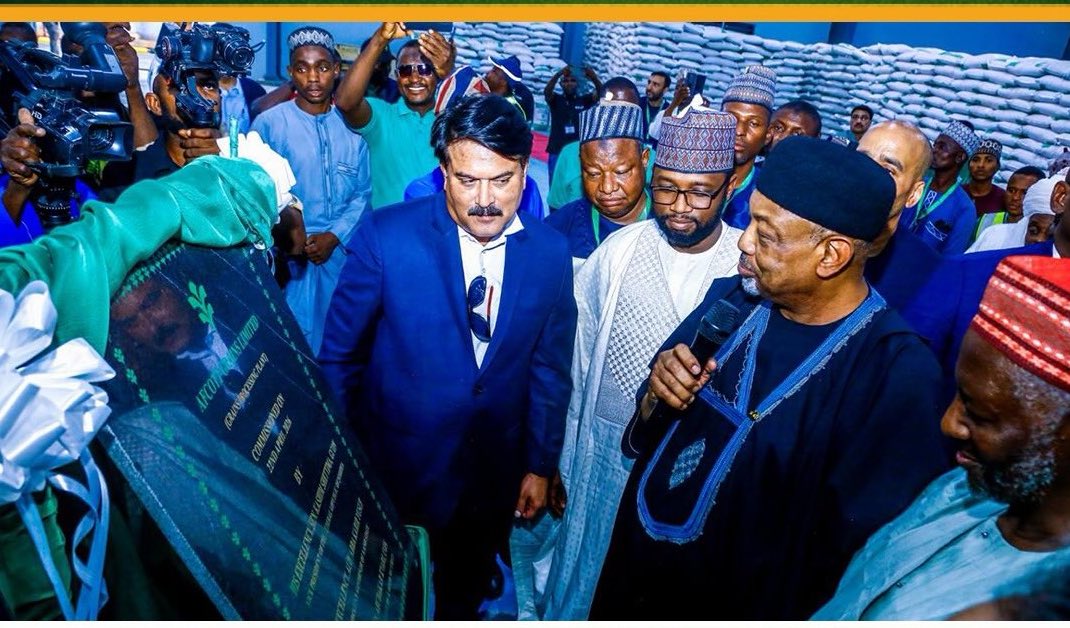
Vice President Kashim Shettima, who spoke at the commissioning of the Afcott Grains-Sesame and Grains Processing Facility at Kawakin Tofa Local Government Area in Kano state recently, stated that the nation’s quest for sustainable food security cannot be met without building strong and integrated industrial capacity across the entire agricultural value chain.
Shettima, represented by the Minister of Agriculture and Food Security, Abubakar Kyari, stated that food production must be matched with processing.
According to him, mechanisation must be matched with financing, adding that policy must be matched with private-sector confidence and long-term investment.
The Vice President described the Commissioning of the Afcott Grains Sesame and Grains Processing Facility as “not merely the inauguration of an industrial plant but a clear statement of the present administration’s resolve toward food sufficiency, value addition, and agro-industrial transformation.”
He disclosed that the siting of the facility in the state was strategic and highly impactful because of Kano’s historic position as a commercial and agricultural hub.
“It strengthens our domestic value chain, enhances export competitiveness, increases farmer incomes and generates meaningful employment opportunities,” he said.
He commended Afcott Grains and its parent company, the Kewalram Chanrai Group, “for their enduring commitment to Nigeria,” noting the Group “has consistently demonstrated long-term confidence in Nigeria’s growth trajectory.”
Shettima emphasised that the investment “builds upon another important milestone achieved just last year, the commissioning of the Springfield Agro Crop Protection Chemical Plant, which since inauguration has produced over 15 million litres of crop protection solutions, significantly strengthening Nigeria’s self-reliance in agro-input supply and reducing dependence on imports.”
“Taken together, these investments represent a deliberate industrial strategy reinforcing our agricultural ecosystem,” Shettima said.
“Agricultural transformation rests on three critical pillars: inputs, mechanization, and processing. While the Springfield Agro Crop Protection facility strengthens input availability, and Afcott Grains expands value addition and processing capacity, mechanization remains essential to scaling productivity nationwide,” he emphasised.
He added that it was important for the country to recognize that Springfield Agro has, over the past two decades, established and sustained a Mahindra Tractor Assembly Plant in Nigeria, playing a pioneering role in advancing the nation’s mechanisation agenda.
He maintained that the initiative goes beyond equipment supply; as it represents technology transfer, local manufacturing, job creation, and the long-term development of a sustainable mechanization ecosystem.
Shettima disclosed that following the submission of a proposal for structured, long-term financing to support mechanization programmes at both federal and state levels, the presidency is currently engaging in constructive dialogue with the company’s management.
He added that such engagement signals a clear pathway toward aligning policy with credible industrial and financing initiatives critical to that goal.
“Accordingly, the Federal Government, under the Green Imperative Programme, has commenced structured mechanisation support across the 774 Local Government Areas of the country, reflecting our firm commitment to modernizing agriculture and improving yields.
“Today’s commissioning therefore aligns seamlessly with our national agenda, expanding domestic production, promoting local manufacturing and agro-industrialisation, scaling mechanized agriculture, creating jobs across the value chain, strengthening export capacity and driving Nigeria decisively toward food sufficiency.”
He commended the Kano state government for providing an enabling environment that continues to attract and sustain investments of this nature, where Development thrives were public leadership and private enterprise working in synergy.
He lauded the management and board of Afcott Grains and the Kewalram Chanrai Group, ‘’your continued investments demonstrate that Nigeria is not merely a market, but a long-term partner in shared prosperity and industrial growth’’
The Vice President pledged that his administration would maintain an open-door policy for credible investors committed to transforming Nigeria’s agricultural landscape.
In his remarks, Kano State governor, Abba Kabir-Yusuf, represented by his Chief of Staff, Suleiman Wali said that the investment reinforced Kano’s position as a leading agricultural and commercial hub in Nigeria and West Africa.
He added that Kano remains one of the most strategic and rewarding investment destinations in Nigeria, with vast agricultural potential and a conducive business environment.
Yusuf revealed that the state government had invested heavily in agricultural mechanization, extension services and irrigation infrastructure to support farmers and attract investors, in line with the Renewed Hope Agenda Policy in the agriculture sector.
Also, Vice Chairman, Kewalram Chanrai Group, Navin Chanrai, said that the facility was designed to produce 40,000 tonnes of sesame seeds and 25,000 tonnes of other grains annually.
Chanrai revealed that the project, completed within 12 months, would create over 500 direct and indirect jobs, with at least 70 per cent of the workforce drawn from Kano State.
He added that the investment was part of the group’s strategy to enhance value addition, boost exports and support Nigerian farmers.















Leave a comment