



From Okwe Obi, Abuja
The Federal Government, through the National Agricultural Development Fund (NADF), in partnership with the Farm Input Support Services (FISS) Nigeria has introduced the first harmonised fertiliser recommendation manual in more than a decade, to improve crop yields, soil health and fertiliser-use efficiency across the country.
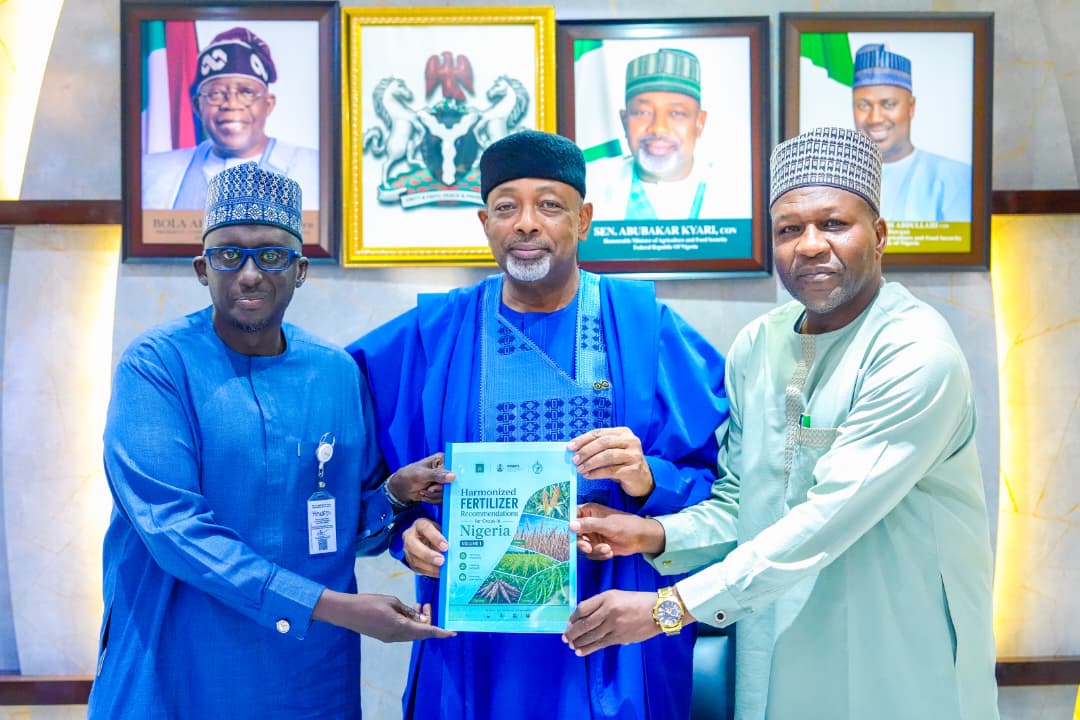
NADF Executive Secretary, Mohammed Ibrahim who presented the harmonised fertiliser recommendations for Nigeria – 2026 Edition to the Minister of Agriculture and Food Security, Abubakar Kyari, yesterday in Abuja, described it as the first phase of a broader national input application guide covering all crops and farm inputs.
Ibrahim said the initiative began in April 2025 after stakeholders identified the need for a unified national fertiliser application framework.
According to him, the effort brought together FISS, the Fertilizer Producers and Suppliers Association of Nigeria, OCP Group and the International Fertilizer Development Center to develop scientifically validated fertiliser recommendations tailored to Nigeria’s farming conditions.
“We brainstormed and agreed that different entities should develop a national input application manual covering all inputs and crops, but because fertiliser remains the most commercially important and complex input, we decided to begin with fertiliser recommendations,” Ibrahim said.
He explained that the process involved a series of technical workshops and validations from June 2025 through February 2026 involving research institutes and agricultural stakeholders before an editorial committee finalised the document.
According to him, the first edition covers five strategic crops, maize, rice, wheat, cassava and cowpea, with plans already underway to extend the recommendations to other crops.
Chairman of the Editorial Committee and Food Systems and Agricultural Advisory Specialist, Professor Christogonus Daudu, said the new guide fills a major gap left since the last national fertiliser manual was issued in 2012 by the then Fertiliser Procurement and Distribution Department, now FISS.
He noted that farmers had since operated with limited information on fertiliser rates, application timing and nutrient management, leading to poor yields, inefficient fertiliser use and declining soil quality.
“Farmers were not getting optimum yields, fertiliser-use efficiency remained low and both government and farmers did not receive adequate returns on subsidy investments,” Daudu said.
He added that the manual was designed not only as a technical document but as a practical field guide for extension agents and farmers.
He said the recommendations were developed using data from major agricultural research institutions, including the Institute for Agricultural Research, Institute of Agricultural Research and Training, National Root Crops Research Institute, National Cereals Research Institute and Lake Chad Research Institute.
Daudu said the manual incorporated fertiliser recommendations across Nigeria’s six agroecological zones and all 36 states and the Federal Capital Territory.
Beyond fertiliser rates, he also introduced sustainable soil management principles such as Integrated Soil Fertility Management (ISFM), the “4Rs” of nutrient stewardship, right source, right rate, right time and right place, and deep fertiliser placement technologies aimed at improving nutrient efficiency.
To make the document usable at farm level, fertiliser rates were converted into bag equivalents rather than kilogrammes, while extension glossaries, nutrient deficiency guides and farmer-friendly language were added.
The editorial committee also recommended translating the guide into major Nigerian languages and deploying digital extension tools such as interactive voice response systems to bridge extension gaps.
Responding, Minister Kyari welcomed the initiative but stressed the need to balance productivity gains with profitability.
“If we increase yields but farmers spend more than the value they gain, then the economic objective is defeated,” he said.
He emphasised that fertiliser recommendations must account for cost-benefit considerations and local soil conditions, particularly in degraded landscapes.
The minister also lamented the decline of agricultural extension systems at state level, describing extension workers as once-critical links between farmers and productivity improvements.
Kyari said the manual should be harmonised with ongoing soil health programmes and expanded to address climate-related challenges such as flooding, drought and erratic rainfall patterns.
He noted that despite Nigeria possessing about 70 million hectares of arable land, only about 30 million hectares are currently utilised, underscoring the need for improved productivity systems.














Leave a comment