



• Commuters groan as fares double
By Steve Agbota
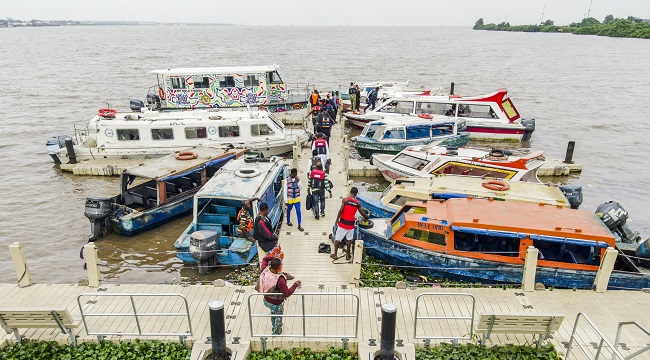
The persistent increase in fuel prices is crippling water transport operations across key routes in Lagos and has forced boat operators to grapple with low patronage and mounting operational pressure. Commuters are also bearing the brunt of the hike, as fares have reportedly doubled in many locations, deepening transport costs and hardship. Operators say the situation has significantly reduced passenger turnout, raising concerns over the sustainability of water transport services if fuel costs continue to rise.
The challenge is believed to stem from the ongoing crisis between Iran and the United States, which affected the movement of oil vessels in the Strait of Hormuz.
The Strait, which handles about 20 per cent of global seaborne oil trade, equivalent to roughly 20 million barrels per day, remains critical to global energy supply. This has forced the global oil prices to rise tremendously as every sector of the economy feels the pain.
However, the nation’s water transport, which is vital for Nigeria’s economy, offering a cost-effective, high-capacity alternative to congested roads, particularly in coastal and riverine areas, has been hampered by the recent fuel increase across the country.
The passengers are no longer patronising the water transport business due to the high fare increase, which has soared beyond 50 per cent, while the boat operators feel the brunt.
For instance, a trip from Ikorodu to Lagos Island, one of the busiest inland water routes in the state, has risen from about N2,000 to as high as N4,000 per passenger, depending on the terminal and time of travel. While Marina to Apapa used to cost N400 now costs N700 per trip.
Conversely, operators said that the increase has become unavoidable due to rising operational costs, especially fuel consumption, engine maintenance, and logistics.
Speaking with Daily Sun, an expert in water transport, Talabi Adeosun, said that the war between Iran and the US majorly caused the increase in fuel, which necessitated the sharp rise in water transport.
“Before the war, a litre of fuel was between N700 and N800. But now, a litre is around N1250 and N1,300. In some states, the price for a litre is even higher. You know the boat operators have to adjust the fare price in order not to run at a loss. They have staff that they will pay at the end of the month, and they will also do maintenance here and there. Now, people are not coming out to use water transport like before. If you go to some jetties here in Lagos, they are no longer as busy as they used to be,” he explained.
He called on the Federal Government to intervene by looking for a way to bring down the fuel price, which can come in the form of a subsidy or palliative, so that businesses that rely solely on petroleum products can survive.
“The government needs to come and intervene, or else the boat operators will just close shops. So there must be a kind of subsidy or palliative to support them in order to stay in business. You can’t blame the passengers for abandoning or patronising them. What is the salary of most of the passengers? So most of them are not even earning N100,000, and they need to survive. The traders don’t even go there because we know what they go through. “ The government just needs to do something to assist these people”, he said.
Meanwhile, the Secretary of the Lagos State Chapter of the Association of Tourist Boats and Water Transport Operators of Nigeria (ATBOWATON), Ayomikun Aworetan, said that the economics of boat operations have changed drastically since the fuel price adjustments, noting that operators are now spending far more to sustain daily movement.
According to him, a single boat trip that previously required about 15 litres of fuel can now consume as much as 35 litres on the same route, depending on water conditions, load, and engine performance.
“You can see the difference is almost 20 litres. When you quantify that against current fuel prices, it becomes a very heavy operational burden,” he said.
Aworetan added that beyond fuel, operators are also struggling with maintenance costs, engine servicing, and general repairs, all of which have increased in recent months.
He noted that many operators are now forced to reduce their daily trips due to low passenger turnout and high running costs.
“As we speak now, the average fare from Ikorodu to the Island is about N3,500 to N4,000. If a passenger returns the same day, that is another N3,500 or more. When you add feeder transport from home to the jetty and from the terminal to final destinations, a commuter may spend close to N10,000 in a single day on transport alone,” he said.
He argued that such costs are no longer sustainable for the average Nigerian worker, especially those earning minimum wage or slightly above it.
“How many people can afford that daily? If someone earns about N70,000 monthly, transport alone can consume over N200,000 if they commute every working day. It is simply not realistic,” he added.
The ATBOWATON secretary further warned that operators themselves are struggling to recover investments, noting that a standard passenger boat with an engine setup costs as much as N15 million. With reduced patronage, he said, many operators can only afford two or three trips per week instead of daily operations.
“Our boats are not moving as frequently as before. Passenger turnout has dropped, and that affects revenue. We are not getting returns on investment,” he said.
He also explained that government intervention projects such as LAGFERRY schemes and subsidised boat services, including Omi Eko initiatives, while helpful in principle, have not fully resolved the sector’s challenges due to high implementation and operational costs.
“Government-owned ferries are subsidised, but private operators are still struggling with fuel and maintenance. Even when intervention boats are provided, the cost of acquisition and operation remains high,” he noted.
On possible government support, Aworetan said operators are calling for subsidies, particularly in fuel or operational grants, to stabilise the sector and prevent further fare increases.
At the jetty in Marina, passengers expressed frustration over the rising cost of water transportation.
A trader, Mrs Funmilayo Ogunleye, who commutes daily to Lagos Island, said she may be forced to reduce her trips.
“I used to spend about N2,000 before. Now it is N4,000 one way. If I go and come back, that is already N8,000. It is too much. I may have to stop coming every day,” she said.
Another passenger, Mr Tunde Balogun, described the situation as “punishing for ordinary workers.”
“We are not even talking about comfort anymore. It is about survival. Some of us may have to go back to road transport even if it is slower, because water transport is becoming too expensive,” he said.
Boat owners say urgent intervention is needed to prevent further disruption to one of the state’s key transport alternatives.















Leave a comment