



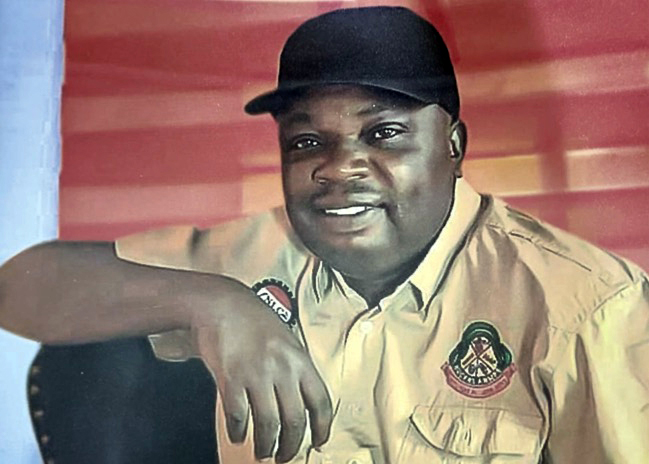

By Bimbola Oyesola
Over the past year, the National Union of Chemical Footwear Rubber Leather and Non-Metallic Products Employees (NUCFRLANMPE)’s trajectory has been closely tied to the health of the industry it represents. According to the President, Bolarinwa Sunday, when employers perform well, the union is better positioned to advocate effectively for workers. Encouragingly, recent feedback from manufacturers suggests a gradual economic rebound compared to the previous year, offering cautious optimism for both employers and employees.
Despite persistent structural and economic pressures, Bolarinwa in this interview notes that the union has recorded notable milestones. From securing a historic wage increase to expanding its membership base across multiple regions, the past year reflects a period of active engagement and measurable progress. These gains, however, sit alongside ongoing struggles, ranging from resistance to unionization in key industrial zones to broader macroeconomic challenges affecting productivity and workers’ welfare.
As the country celebrates another May Day, the mood among workers remains mixed. While there are visible improvements and renewed efforts within the union, many workers are still grappling with the realities of rising living costs and job insecurity. For the union leadership, this moment underscores both the urgency of sustained advocacy and the need to consolidate recent gains into long-term protections for workers.
Excerpt:
How has the union fared in the past year?
The strength of our union is closely linked to the performance of the employers we work with. When they are thriving, it creates room for meaningful engagement and progress. When they struggle, it limits what we can achieve. That said, there are clear signs of improvement in the economy. Feedback from manufacturers indicates better conditions than we experienced last year, which gives us reason to be hopeful.
Looking back at your promises since assuming office in 2024, what measurable achievements have you recorded?
One of the most important expectations of any worker is a salary increase that can ease daily living. Under my leadership, we successfully negotiated and implemented an annual increment under the National Joint Industrial Council (NJIC) agreement. This increase of ₦25,000 across the board, was the highest in the union’s history. It represents a significant leap from the previous ₦14,000 increment, especially given the economic challenges.
I must acknowledge the cooperation of the employers’ association, which played a supportive role throughout the process. Importantly, about 99 percent of employers have complied with the agreement and paid their workers accordingly.
Beyond wages, we’ve also made visible progress in infrastructure and development within the union. Renovation projects are ongoing, and we have awarded contracts for key developments, including an ultramodern multipurpose shopping complex nearing completion. Once operational, it will generate additional revenue to support union activities.
Membership expansion has also been a major success. Between September 2024 and September 2025, we unionized about 30 new companies, bringing in roughly 30,000 workers. Since then, we’ve added another 10 companies. This growth reflects our commitment to strengthening the union’s reach and influence.
What challenges are you facing with unionization in the Sagamu axis?
Sagamu remains a particularly difficult area. There are about 57 companies in that industrial zone, many of which are strongly resisting unionization. A significant number of them rely on casual labour, hiring workers on short-term contracts and cycling them every three months to avoid long-term obligations.
In some cases, access to these facilities is physically restricted, with security personnel preventing engagement. Many of these companies are linked to influential individuals, which complicates enforcement efforts. We have reported these issues to the Ministry of Labour, but action has been limited.
We are now working closely with the Nigeria Labour Congress (NLC) and preparing for coordinated action, including possible picketing, to address these challenges.
Where are the newly unionized companies located?
They are spread across different parts of the country, although Sagamu remains a focal point of concern. Conditions there are troubling, with workers often exposed to poor treatment and unsafe environments.
Some companies operate with little transparency, making it difficult to assess their compliance with labour standards. In certain cases, workers are exposed to hazardous materials without adequate protection. These are issues we have been actively addressing over the past few years.
To give you specific names, here are a few: Shafel Ind. Limited, 100 Stars Ind. Limited, Hanushi Manufacturing, Saro, Nig limited, Stova Ind. Limited among other Lebanese, Indian and indigenously owned companies
There are also some Nigerian-linked ones, such as a battery manufacturing plant owned by Christ Embassy Church. The chemicals involved, like lead, are extremely hazardous—if they come into contact with blood, they can cause gradual poisoning and even death. Yet, there’s no union protection, and workers are exposed without safeguards. This church-owned entity hides behind a facade. We’ve been battling this for the past two years or so.
Some other Chinese conglomerates have multiple companies under one umbrella—producing items like umbrellas, leather goods, shoes, and more—but often without clear signposts or transparency. The Ministry of Labour has been approached, but their efforts feel intentional in their inadequacy; corruption and fear of powerful owners seem to stall progress. As I mentioned, our next step is picketing, which we’ll execute carefully. Access is heavily restricted with soldiers, mobile police, and paramilitary forces guarding entrances—they don’t even accept negotiation letters. We’ve spoken to some workers discreetly, but without formal entry, they’re not fully protected.
What broader challenges is the union facing?
Funding remains a key issue. The cost of operations, legal disputes, and members’ support continued to rise. Many employers resort to litigation, which further strains our resources.
Energy costs are another challenge. Although diesel prices have eased somewhat, power supply remains unreliable, forcing companies to depend on generators. This drives up production costs.
We’ve seen multinationals exiting Nigeria between 2020 and 2025 due to power, roads, and other issues, but with economic indices improving, some are reconsidering. For example, PZ was on the verge of leaving but has decided to stay, likely due to these stabilizations. I anticipate more will return.
On the positive side, foreign exchange conditions have improved. The removal of multiple exchange rates has created a more transparent system, making it easier for manufacturers to access foreign currency.
However, high interest rates currently above 20 percent remain a major obstacle for businesses, making it hard to borrow, pay salaries, and sustain operations.
While food prices have started to decline, the cost of living is still a concern for workers.
How would you assess the government’s performance?
There has been progress in infrastructure development, particularly in road construction. The use of durable materials and improved planning is encouraging.
Efforts in the power sector are also notable, especially with increased attention to renewable energy. However, more investment is needed in the national grid to support large-scale industrial activity.
Security, unfortunately, remains a major concern. Insecurity disrupts supply chains, affects production, and discourages investment. It is an area where much more needs to be done.
What are your key demands from President Bola Tinubu
If I had President Tinubu sitting here, my three non-negotiable demands would be: First, declare a state of emergency on security to safeguard lives and property. Second, curb the excessive influence of exploitative foreigners posing as investors—many, especially some Chinese, come to exploit rather than invest; require substantial capital thresholds for entry to prevent them from taking more than they bring. Third, prioritize electricity as the backbone of industrialization—get it reliable and affordable to let industries thrive.
What training programmes have you implemented for members?
We’ve been quite active in the area of training recognizing that education and skill-building are essential for our members’ growth. We’ve conducted numerous programs, including specialized training on women’s activities to empower female members. We’ve also partnered with the ITUC for organizing training, which focuses on effective union strategies. Additionally, we’ve held sessions on climate change to raise awareness about environmental impacts on labour in partnership with the Friedrich-Ebert-Stiftung.
We also introduced a workplace sexual harassment policy, now embedded in our constitution, to ensure safer work environments for all members.
Are some companies exploiting workers under the guise of economic hardship?
Yes, that does happen. Some companies use the economic situation as an excuse to lower standards, even when they are performing well. We challenge such practices by holding them accountable and insisting on fairness.
For established firms like Unilever, which have a history of decent treatment, we hold them accountable: if their market is strong and sales are up, they can’t suddenly downgrade worker conditions under the guise of economic issues. We review their past practices and challenge any retrogression.
However, it’s tougher with opaque operations like many Chinese or Lebanese companies—they rarely share balance sheets or production costs. You see goods being produced and shipped, but transparency is minimal. Under the law, there are provisions for oversight via unions or the ministry, but enforcement is weak. Our metrics include checking if they meet national minimum standards like NJIC payments; if they could afford more, but don’t, we negotiate harder. Civilized European-owned companies tend to be more transparent and fair, while others from developing nations stick to bare minimums.
May Day and state of workers- celebrating or enduring?
In reality, many workers are enduring rather than celebrating. While May Day will be observed, the economic realities mean that survival is the priority for most people. If you speak to someone who worked in the 1980s, they’d tell you how much better conditions were then compared to now. Today, many are simply trying to make ends meet, which allows employers to exploit the job scarcity—offering minimal terms which people accept just to keep body and soul together.








Leave a comment