



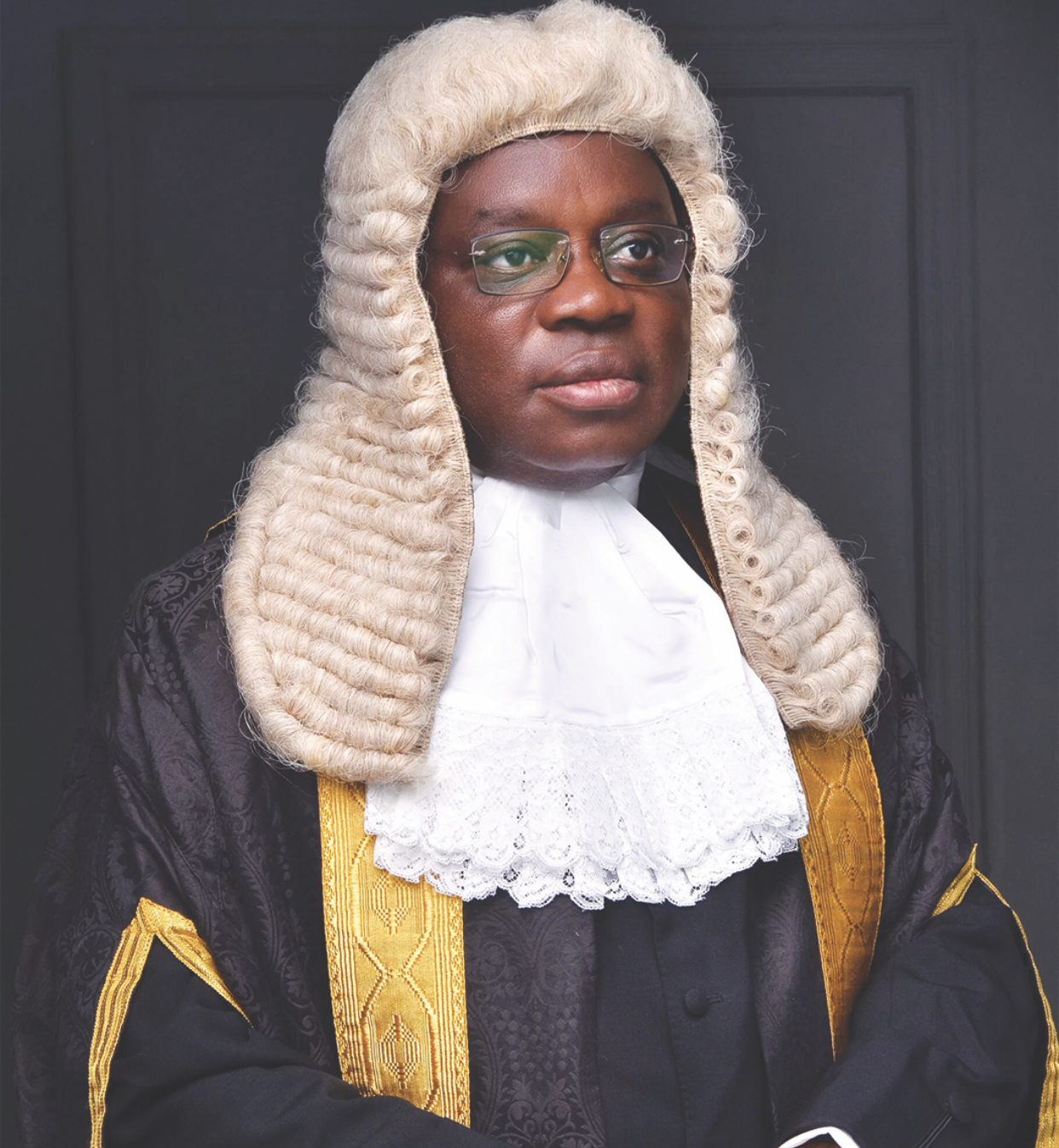
Dr. Joseph Agburuwhuo Nwobike, is a distinguished Nigerian lawyer, founder of Osborne Law Practice, and a Senior Advocate of Nigeria. From Port Harcourt to legal prominence, his journey is marked by academic excellence, professional dedication, and philanthropy. Beyond law, Nwobike has contributed significantly to society, including donating a church building to the Redeemed Christian Church of God in 2018 and constructing the Nigerian Bar Association Isiokpo Branch secretariat in 2022. He also serves as Chairman of Falcon Media Limited and sits on the Advisory Board of the Institute for Law and Technology at the Centre for American and International Law. In this conversation with Wale Igbintade, he discusses his career, philosophy, and legal insights.
W
hat inspired you to study law, and how early in life did you know this was your calling?
When I was in Secondary School, particularly at the Government Comprehensive Secondary School in Port Harcourt, we were encouraged to read a wide range of materials including those related to politics, economics, international affairs, etc. At the time, the late Chief Obafemi Awolowo, SAN, Alhaji Waziri Ibrahim, Mallam Aminu Kano, Dr. Nnamdi Azikiwe and Alhaji Shehu Shagari were campaigning for the general elections. The politics of that time was very healthy and interesting as the aspirants and their supporters across the spectrum discussed and campaigned on issues of development, social cohesion and emancipation of the peoples of Nigeria. Of all these politicians, I took a particular interest and admiration in Chief Obafemi Awolowo. That was one of the reasons why I took more than a passing interest in law. Another reason was the influence which lawyers whose offices were located in Port Harcourt at the time. They included Chief Wobidike Wonodi, SAN, Chief the Honourable Oragbule Adiele, Mr. R. R. Briggs, G. A. Graham Douglas, SAN and a host of others. These circumstances and personalities largely influenced my determination to study law, in my formative years. I must also confess that very early in life, I discovered that I could not really study sciences due to the problems I encountered in understanding mathematics, physics and the likes. Law naturally, therefore, became my choice.
Was there a specific moment or person that influenced your decision to become a lawyer?
I resumed at the Faculty of Law, University of Lagos, and quickly settled into serious academic work. At the Faculty, we had very experienced and exceptional lecturers like late Professor Jelili Adebisi Omotola, SAN, Professor A. A. Adeogun, Professors Akanki, Agbede, Fogam, Ovieghara, Obilade, Adeyemi and a host of others. I must confess that their individual and collective methods of teaching were quite inspiring. Due to the exceptional intensity of the academic work we engaged in at the time, it became a challenge for a number of us to excel. Do not also forget that Faculty of Law, University of Lagos, being the foremost faculty for the teaching and research in law at the time, undertook a number of programs that exposed us to emerging trends in all aspects of law through seminars, national workshops, etc. It is my view, therefore, that attainment of excellence became a burden that we had to discharge to justify the quality of legal education that we freely and continuously received in the faculty. Luckily, at graduation, I was one out of the three (3) or four (4) graduands who earned the upper class division that year.
Can you share some memories of your undergraduate days? What was campus life like?
My undergraduate years were very exciting, challenging, and educative. It was the period when we made friends and learnt how to relate with people of diverse backgrounds, faiths and dispositions. It is, in my view, a very interesting time.
Apart from my academic endeavors, I took out time to also participate in leadership activities. For instance, I was elected as the Secretary General of the National Union of Rivers State Students (NURSS). I contested and won the election as the Secretary-General of the University of Lagos Students’ Union (ULSU) for 1990/1991. I participated in several University activities and represented the students in a number of University Committees. One man who made my engagement at the Students’ Union very educative and inspiring was Mr. Olu Shodimu. At the time, he was the Student Affairs Officer. I was privileged to work with a very dynamic cabinet led by Olusegun Maiyegun. Our administration handed over to Omoyele Sowore, after he was elected as the President of the Students’ Union.
How did your upbringing shape your worldview and values?
I was born into a fairly educated, comfortable and conservative Ikwerre family. My parents were civil servants. I come from the large families of Nwobike and Ngofa in Rivers State. I had uncles who served my State as Commissioners, Permanent Secretaries, and the likes. So, I grew up in Port Harcourt, which was and has remained a multi-ethnic, multi-racial, multi-religious city. Coming from such a background, my views were structured to see the world as a global village. That level of exposure would later influence the choices that I made. As you may know, I took a wife from the Ijebu stock of the Yoruba race of Ogun State, and have friends from all parts of the country. My views on issues are not, therefore, defined by ethnic considerations or other negative criteria. The background also enabled me to see the reason to pursue my passion with every sense of responsibility, openness and humility.
You became a Senior Advocate of Nigeria in 2009. What did that recognition mean to you?
Immediately I sat and passed the qualifying examination at the Nigerian Law School, I settled down as a Youth Corper with the prestigious firm of Adedeji and Owotomo. The Firm exposed me very early to the intricacies of litigation. From that point, I made up my mind to settle with litigation as against other opportunities that came my way at the time. I took out time, during my early years of practice, to attend post-graduate schools and acquire other professional qualifications. I conducted several cases which eventually qualified me to be appointed as a Senior Advocate of Nigeria (SAN) in 2009. Earlier in 1999, I had been sworn in as a Notary Public for Nigeria. I believe that, in my little way, I have conducted cases that have contributed to the development of the Nigerian legal system and jurisprudence.
What were some defining moments before attaining SAN?
I have had to deal with a number of challenges in the course of my career as a lawyer and adult. As you are aware, I had to deal with a personal case which ended up at the Supreme Court in my favour. I also believe that the case has helped practitioners and stakeholders to understand some aspects of our public law better. Another significant challenge that I faced was the loss of my darling wife to cancer in 2019. It was a defining moment, and I thank God for the inner strength with which I managed all that. I also wish to thank my children and friends for the support and strength through those challenging times.
What unique challenges have shaped your practice philosophy?
It is a truism that no two instructions or cases are the same. Each case generates its own lessons, challenges and opportunities. It will be safe to simply assert that the work of a lawyer is a learning process and should be seen as such. It is a profession that imposes the duty to learn and research on a continuous basis. Lastly, lawyering can only become successful when it is perceived as teamwork and an enterprise. It is neither a social work nor a charity vocation.
What lessons have you learnt from handling litigation at all levels in Nigeria and abroad?
I hold a Master of Laws degree and a doctorate in law. I am also a fellow of the Chartered Institute of Taxation of Nigeria, the Chartered Institute of Arbitrators of the United Kingdom, and Business Recovery and Insolvency Practitioners of Nigeria, amongst others. I decided early in my career to specialise in litigation practice and deepen my specialty through dedicated postgraduate and professional education. It has been very rewarding, helpful and supportive. As they say, a lawyer must strive to be knowledgeable in all and a master of the law.
How has academic research influenced your approach to advocacy?
I must confess that my postgraduate and professional qualifications have helped to define the depth and quality of my work as a lawyer over the years. It has also enriched my advocacy and legal consultancy skills immensely.
Which of your published legal articles do you consider particularly impactful?
In the course of my career as a researcher and legal practitioner, I have published a number of law articles and papers on a wide range of topical issues and subjects. Some of these articles have been cited by other researchers and have also helped in law practice and development in some jurisdictions. I will say that each and every of such research work has been impactful in a number of ways.
How relevant is academic scholarship to law practice in Nigeria today?
As we all know, law is dynamic and a product of the interplay between the need to predict conduct and to induce order. That being the case, law is the result of rigorous exercise of reasoning and analysis of the strategies to achieve the law-making objective. The making of laws, therefore, is expected to draw from past experiences of scholars, lawmakers, sociologists, etc. Thus, one of the critical sources of law is scholarly works of notable scholars. The courts, in some cases, rely on those scholarly works and criticisms. The law makers also, in appropriate cases, respond to scholarly works or commentaries by learned scholars expressed in articles, etc. Academic scholarship cannot, therefore, be divorced from law practice in Nigeria.
Your areas of interest include public interest litigation, tax, capital markets, and legislative advocacy. What ties these fields together?
My areas of special interest is a product of my experience and activities over the years. They are commonly woven around my view that law must be applied to solve real and deserving problems. My training at the University of Lagos opened me up to look at law, amongst others, as a means of creating value for the clients.
You were instrumental in the Chartered Institute of Local Government Act, 2017. How did that journey unfold?
The instruction to draft the Bill to establish the Chartered Institute of Local Government and Public Administration of Nigeria was given to me in the year 2000. I actually drafted the Bill in 2000. The client, the then Institute of Local Government and Public Administration of Nigeria, further instructed me to follow through and manage the entire process of law-making at the National Assembly. It was an exercise that led me to understand the politics and intricacies of sponsoring and passage of private Bills at the National Assembly in Nigeria. The Bill was passed by both Chambers of the National Assembly shortly before the administration of President Goodluck Ebele Jonathan came to an end. The Bill had to go through the entire process de novo. As God will have it, both Chambers passed the Bill and President Mohammadu Buhari, GCFR assented to the Bill in January, 2018. I feel highly satisfied and grateful to the members and Council of the Institute for the opportunity to carry out the assignment. It also offered me the opportunity to become fairly grounded in legislative advocacy in Nigeria. A great and inspiring experience.
How do you see the future of legislative advocacy and legal reform?
Legislative advocacy is a very interesting practice area. One of the problems that I found out is that most legislative engagements of the legislative houses in Nigeria do not take the benefit of lawyers experienced in legislative advocacy. Legislative advocacy is not just legislative drafting. It extends to other components of legislative journey of every law passed by every legislative house. Legislative input and research management are very critical and beneficial to law making. It is hoped that lawyers will dive into this area and apply their skills for the benefit of the legislative process and the general public in Nigeria. Legislative advocacy should also extend to law reforms as managed by the Law Reforms Commission and Law Review Committees of various States.
What values have guided you personally and professionally?
I am a single parent. So, apart from my engagements as a lawyer, I take time to attend to the needs of my children regardless of the fact that they are now adults. I am a community person. That deep-rooted love, gets me involved in the affairs of my communities at my State of birth and State of residence. I am not a member of social clubs but I do find time to socialize with friends occasionally. I also do the things of God, as directed by the Holy Spirit.
Outside law, what does a typical day look like?
I love music. I listen to all types of songs from the old to the new. I find Ebenezer Obey, Stephen Osita Osadebey, J. O. Araba, Cardinal Jim Rex Lawson, Kayode Fashola and Fela Anikulapo as very interesting. I also listen to Peter Tosh, Bob Marley, Black Uhuru, Don Carlos, Toots and the Maytals, etc. Contemporarily, I listen to Davido, Burna Boy, Black Sheriff, Seyi Vibes, etc. I, whenever time permits, play lawn tennis.
How do you find balance amid a demanding legal schedule?
I strive to do my best in all endeavours and uphold integrity in personal and professional life.
You mentor young lawyers at Osborne Law Practice. What principles do you instill?
I mentor young lawyers. I relate with them professionally. I believe that example is the best teacher. I have two (2) children who are lawyers. I teach them by what I do. The best way to bring up your children or those who look up to you is to lead by example.
What advice do you have for aspiring SANs?
Those who aspire to grow in the profession generally should be intentional about their ambition. They need to understand that organic growth is easier to sustain. They must also understand that there are procedures which must be followed. They should understand that they must play by those rules. For those who aspire to take the Silk, I advise them to take litigation work seriously and document their works. Relating with experienced lawyers will also be helpful for guidance. Lawyers should understand that they need to grow vertically and horizontally which means that the must grow in all aspect of their lives.
What legacy do you hope to leave in Nigerian law?
I hope to be remembered as a good man who dedicated himself to helping humanity and advancing the legal profession.















Leave a comment