



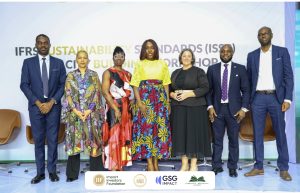
L-R: Abam Iyang, Senior Associate, LBS Sustainability Centre; Director, ISSB, Dr. Ndidi Nnoli; Tokunboh Ishmael, Managing Partner, Alitheia Capital; Etemore Glover, CEO, Impact Investors Foundation; Lee Swan, Head of Sustainability at Alexforbes; Femi Shobanjo, CEO of NGX Regulation Limited; and Dr Eberechi Weli, Chief Executive, SALI Technology, UK at the IFRS Sustainability Reporting (ISSB) Capacity Building Workshop
By Chinenye Anuforo
Nigeria is ramping up efforts to align with global sustainability reporting standards as it seeks to unlock capital flows needed to close its estimated $31.5 billion annual financing gap for the Sustainable Development Goals (SDGs), amid a broader $1 trillion yearly shortfall across developing economies.
At the centre of this push is the growing adoption of the International Sustainability Standards Board (ISSB) framework, which regulators, policymakers, and market operators now see as critical to boosting investor confidence, improving corporate transparency, and positioning Nigeria competitively in global capital markets.
This move was underscored at a three-day IFRS Sustainability Reporting (ISSB) Capacity Building Workshop in Lagos, convened by the Impact Investors Foundation (IIF) and the Corporate Reporting Academy (CRA), where stakeholders emphasized that credible sustainability disclosures are fast becoming a prerequisite for accessing international investment.
Chief Executive Officer of IIF, Etemore Glover, said Nigeria’s sizeable SDG financing gap highlighted the urgency standardised ESG reporting frameworks capable of attracting private capital at scale.
She noted that as sustainability disclosures increasingly shape global investment decisions, countries that fail to align risk being excluded from capital flows.
“These standards are no longer optional. Investors now rely on sustainability-related financial disclosures to assess risk, resilience, and long-term value. For developing economies, closing the $1 trillion annual SDG financing gap depends significantly on how well we standardise and communicate environmental and social impacts,” she said, stressing that Nigeria’s $31.5 billion gap remains a critical pressure point.
The workshop marked a shift from awareness to execution, with a strong focus on equipping institutions with the technical capacity required for mandatory sustainability reporting under ISSB standards.
Chief Executive of CRA, Dr. Iheanyi Anyahara, described the transition as a strategic inflection point for Nigeria, noting that the country must now move beyond advocacy to building systems, skills, and frameworks that enable effective implementation.
According to him, strengthening reporting capacity will not only help Nigeria bridge its financing gap but also enhance its attractiveness to global investors and improve its competitiveness among emerging markets.
Industry stakeholders at the event agreed that Nigeria is moving from debating the relevance of sustainability to enforcing measurement, disclosure, and accountability.
A member of the IIF Board of Trustees, Adewale Ajayi, said the country is at a “critical junction,” where businesses must adopt globally recognised reporting standards or risk falling behind.
“The conversation has evolved. It is no longer about whether sustainability matters, but how we measure it, how we disclose it, and how we ensure accountability,” he said.
Ajayi added that the adoption of IFRS S1 and S2 standards would significantly strengthen corporate governance and investor trust by requiring companies to disclose sustainability-related risks, opportunities, and climate impacts in line with global best practices.
Regulators also signalled strong support, with the Securities and Exchange Commission (SEC) reaffirming its commitment to a structured and phased adoption approach.
Director-General of the SEC, Dr. Emomotimi Agama, who spoke through the Commission’s Divisional Head of Legal (REMI), Tony Iloka, acknowledged the technical complexity of sustainability disclosures, particularly around emissions accounting and value chain assessments.
He, however, assured stakeholders that implementation would be pragmatic and capacity-driven.
“We are not in the business of mandating standards that the market cannot effectively implement. Proportionality, phased adoption, and capacity support will define our approach,” he said.
Despite concerns about readiness, the SEC pushed back against claims of limited capacity, citing Nigeria’s successful transition to IFRS, adoption of global auditing standards, and implementation of the Companies and Allied Matters Act (CAMA) 2020 as evidence of institutional resilience.
“The issue is not capacity deficiency, but the need for a structured, well-resourced implementation programme,” Agama noted.
With sustainability disclosures taking centre stage in global finance, stakeholders say Nigeria is positioning itself not just as a participant, but as a potential regional leader in ESG reporting, one capable of setting the pace for transparency, accountability, and sustainable growth across Africa.
As implementation gathers pace, the success of ISSB adoption may ultimately determine how effectively Nigeria converts transparency into tangible capital inflows and whether it can realistically close its $31.5 billion annual SDG financing gap.














Leave a comment