



Nigeria must ensure that its partnership with the United States remains clearly defined, transparent, and anchored in Nigerian interests, writes
FELIX OLADEJI
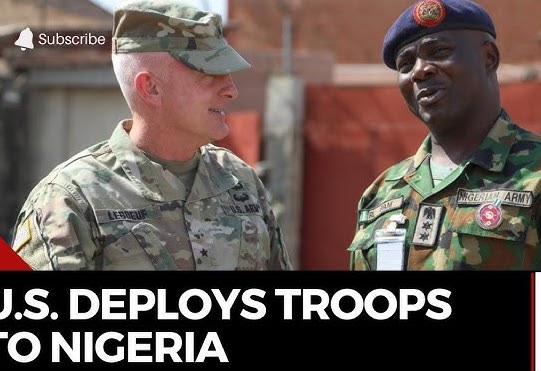
The arrival of the first batch of United States troops and military aircraft on Nigerian soil marks a consequential moment in the evolving security relationship between Abuja and Washington. According to official statements, the deployment is designed to strengthen Nigeria’s counter-terrorism capacity through training, intelligence sharing, and logistical coordination. Yet beneath the surface of diplomatic assurances lies a development that demands serious national reflection.
Nigeria is not a failed state in search of foreign guardianship. It is Africa’s most populous nation, with one of the continent’s largest standing militaries and decades of experience in regional peacekeeping. From Liberia and Sierra Leone to The Gambia, Nigerian forces have historically projected stability beyond their borders. That history makes the symbolism of foreign troops landing on Nigerian soil especially potent.
The federal government insists that the American personnel are here strictly in an advisory capacity. They are not combat troops, officials emphasize, but trainers. The distinction matters. Nigeria retains operational control. There is no formal declaration of joint combat operations. The deployment is framed as a technical partnership aimed at improving tactical coordination, surveillance capabilities, and counter-insurgency effectiveness.
On paper, this rationale is understandable. Nigeria faces a security crisis of alarming proportions. Boko Haram and ISWAP continue to destabilize parts of the northeast. Armed bandits terrorize communities in the northwest. Kidnapping for ransom has metastasized into an industry. Communal clashes and farmer-herder conflicts simmer across the north-central region. Insecurity has disrupted farming, deepened poverty, displaced millions, and eroded citizens’ confidence in state institutions.
In such circumstances, enhanced training and intelligence support from a technologically advanced military power may appear pragmatic. Modern counter-insurgency warfare is data-driven, surveillance-heavy, and coordination-dependent. Drones, satellite imaging, electronic intelligence, and integrated air-ground operations can make the difference between success and prolonged stalemate. If American support helps close these capability gaps, the Nigerian military could gain an operational edge.
But capability is only one dimension of security. The deeper question is whether foreign military presence, however limited, addresses the structural drivers of Nigeria’s insecurity. Terrorism and banditry do not thrive merely because of tactical weaknesses. They flourish in environments marked by governance deficits, corruption, youth unemployment, porous borders, and alienation from the state.
There is a risk that foreign military collaboration becomes a convenient substitute for domestic reform. It is far easier to announce high-profile international cooperation than to confront entrenched internal failures; security sector accountability, transparent procurement, effective intelligence coordination among agencies, and the rebuilding of trust between communities and the armed forces. Without institutional reform, foreign training risks becoming a temporary patch on a systemic wound.
There are also sovereignty considerations that cannot be dismissed as mere nationalism. Nations are judged not only by their economic indicators but by their ability to safeguard their territorial integrity independently. While military cooperation is common in international relations, hosting foreign troops, even in a training role, carries symbolic weight. For many Nigerians, it may evoke uncomfortable memories of external interference on the continent.
Africa’s history is replete with examples of foreign powers whose security engagements evolved into prolonged influence. From Cold War proxy dynamics to contemporary geopolitical competition, military cooperation has often doubled as strategic positioning. Nigeria must therefore ensure that its partnership with the United States remains clearly defined, transparent, and anchored in Nigerian interests.
The geopolitical context further complicates the picture. Global power competition is intensifying in Africa. Western governments, China, Russia, and regional actors are all recalibrating their presence on the continent. Security partnerships are rarely isolated from broader strategic calculations. Nigeria’s alignment choices inevitably send signals about its foreign policy trajectory.
That does not mean Nigeria should shun cooperation. No nation operates in isolation, particularly in an era of transnational terrorism. Intelligence sharing across borders is indispensable. Extremist networks do not respect national boundaries; neither should counter-terrorism collaboration. But cooperation must not slide into dependency.
Transparency is therefore essential. Nigerians deserve clarity about the scope, duration, and metrics of this deployment. What precisely will the American troops train Nigerian forces to do differently? How will success be measured? What safeguards exist to ensure that civilian populations are protected and that human rights standards are upheld? These questions are not hostile; they are democratic necessities.
Equally important is parliamentary oversight. Security agreements should not reside solely within the executive branch. The National Assembly has a constitutional role in scrutinizing arrangements that touch on sovereignty and national defense. Open debate strengthens legitimacy and builds public trust.
Another layer of concern involves narrative framing. In recent years, segments of international commentary have portrayed Nigeria’s insecurity through overly simplistic lenses; sometimes reducing it to a singular religious conflict. Such framings distort a complex reality in which victims span ethnic and religious divides. Nigeria must guard against external narratives that oversimplify its crisis in ways that could distort policy responses.
Security is ultimately local. Villagers in Zamfara or Borno do not experience geopolitics; they experience fear, displacement, and economic ruin. For them, what matters is whether farms are safe, markets reopen, and children return to school. If foreign training contributes meaningfully to these outcomes, it will earn legitimacy. If it merely adds another layer of elite diplomacy without changing realities on the ground, public skepticism will deepen.
The federal government must therefore resist the temptation to present this development as a silver bullet. Military partnerships can enhance capacity, but they cannot resolve grievances rooted in poverty, marginalization, and political exclusion. Sustainable peace requires development, education, justice, and credible local governance. It requires rebuilding the social contract between citizens and the state.
There is also an opportunity embedded in this moment. Nigeria can use the partnership to demand more than tactical training. It can insist on collaboration in areas such as border security technology, maritime domain awareness in the Gulf of Guinea, and capacity-building for civilian oversight institutions. A mature partnership should extend beyond the battlefield to institutional strengthening.
For the United States, this deployment should signal respect for Nigerian agency rather than paternalism. True partnership recognizes Nigeria not as a security liability but as a regional anchor whose stability benefits the entire West African subregion. The tone and conduct of American personnel will matter as much as the technical content of their training.
Ultimately, the presence of U.S. troops on Nigerian soil is neither a national humiliation nor a guaranteed breakthrough. It is a strategic choice made in a time of crisis. Like all strategic choices, it carries risks and opportunities.
The burden now rests on Nigerian leadership to ensure that this cooperation strengthens, rather than dilutes, national capacity. Security cannot be permanently outsourced. A nation of over 200 million people must build institutions capable of defending its citizens without perpetual external scaffolding.
If this deployment becomes a catalyst for reform, professionalism, and renewed public confidence in Nigeria’s armed forces, it may prove a turning point. But if it evolves into quiet dependency or a distraction from deeper reforms, history will judge it harshly.
Stability will not ultimately be secured by foreign boots on Nigerian soil, however well-intentioned. It will be secured when Nigeria’s institutions are strong, accountable, and responsive to the needs of its people. That is the enduring challenge and the true measure of sovereignty.
Oladeji writes from
Lagos














Leave a comment