



Jess Castellote
The other day, while taking a slow stroll around the parking area of my house, I stopped by the hedge that lines it. The sun was filtering through the leaves, and I found myself absorbed in the play of light and shadow. Some leaves shined with a tender, almost translucent green, while others had darker tones. The hedge was nothing remarkable, something I usually walked past without thought, but that day its greens seemed to shift endlessly, as if the plant had a hundred hidden shades I had never noticed before. Simply standing there, letting the little differences in light and shade hold my attention, felt like being handed something unexpected and generous. Standing before that hedge, I thought of the importance of giving attention.
I had read a few days earlier something that Simone Weil (1909-1943), the French philosopher and activist once wrote: “attention is the rarest and purest form of generosity.” Initially, this association came as a surprise. But I began to understand how the deliberate practice of attention can be an act of generosity. Most of the time when we hear ‘generosity,’ we think of giving things away: money, belongings, time, help. Yet there is another kind of giving: simply paying attention, staying with something long enough that it matters more than our distractions. Attention is relevant for all aspects of life, but looking for more ideas on the practice of attention and how this applies to the arts, I came across Iris Murdoch’s book The Sovereignty of Good. Murdoch (1919-1999), both a novelist and a philosopher, sees attention as central to how we grow and change as people. She points out how our natural tendency is to perceive the world through the distortions of self: our fantasies, self-interest, and projections. Reading her, I began to see that attention is less about straining to focus and more about slowly letting the world show itself as it really is.
Murdoch brings the idea of “unselfing.” True perception is hard because the ego is always in the way, colouring what we see. What can break this circle is patient, receptive looking. In other words, attention. To pay attention rightly is to step out of the circle of the self and let the reality of another, whether a person or a hedge of sunlit leaves, stand before us without being reduced to our categories. In The Sovereignty of Good, she writes that beauty, especially natural beauty, draws us beyond ourselves. In such moments of genuine attention, we do not shrink but expand. But what strikes me most about Murdoch is how she argues that art can sharpen our capacity for attention. A painting, a sculpture, a piece of music asks us to be still and wait, and then be ready to receive. I am increasingly convinced that to contemplate art is not simply to “look at” something, but to practice a far deeper way of seeing. By becoming a school of perception, art can do more than decorate or entertain. A serious work of art does not give itself up at once. It resists being consumed or reduced; instead, it asks for time and attention. This is why art also sharpens our ability to attend to life. Not because it preaches moral lessons, but because it teaches us to look without the self rushing in. When we read a novel well, we enter another’s life with patience and openness.
When we stand before a painting without leaping to judgment, or when we listen closely to music, we to yield to time and sound, allowing ourselves to be carried rather than in control. These are all acts of attention, and at their best, acts of unselfing.
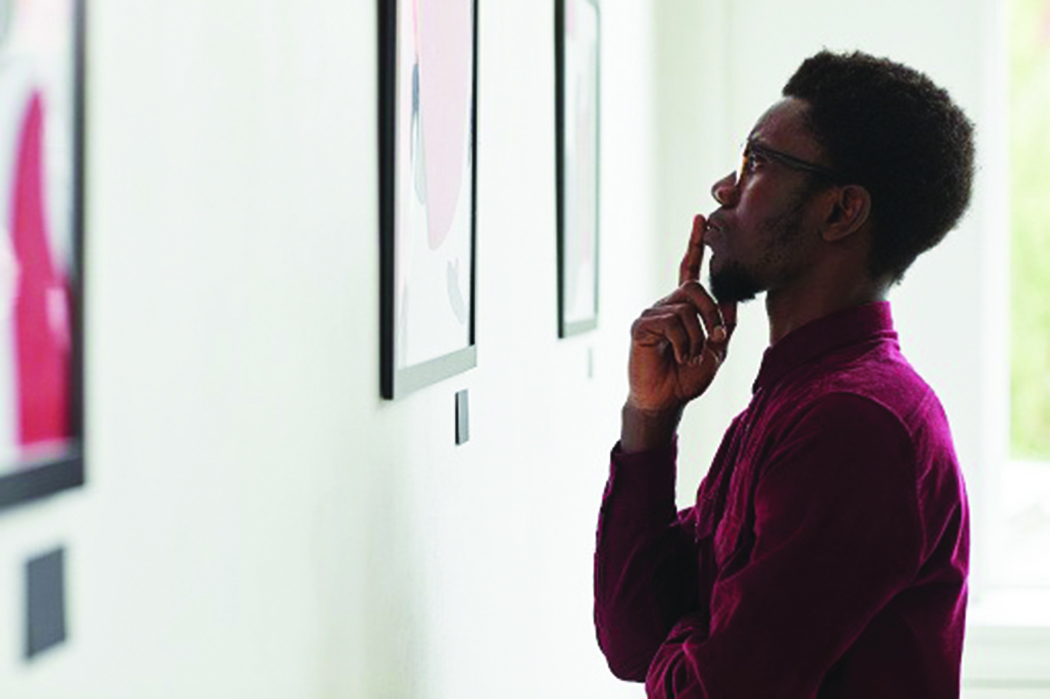
I see this frequently at the Yemisi Shyllon Museum of Art (YSMA), where I work. The museum is filled with works that ask for attention. I have watched visitors fall silent before a piece, their initial restlessness giving way to absorption. In those moments, I resist the urge to explain. If they are already attending, it is better for me to remain silent and let the work itself hold them and ask for their attention. That is why, all of us at the YSMA are increasingly convinced that the museum is not merely a place of display but of growth. It can be a place where attention is nurtured. It can teach us that we are not at the centre of all things, because to attend is to recognise the reality of the other, whether a person, an artwork, or a flicker of sunlight on green leaves. Murdoch is right to say that love, beauty, and truth are attention freed from ego. These are lofty ideas, yet they are rooted in ordinary practices. To attend in silence without reaching for distraction is not idleness. Pausing by a hedge and notice its play of hues, or lingering before a painting, resisting the impulse to photograph it and move on, are not wasted time. Each is a moment in which the self loosens its grip and reality is allowed to appear. They are, in Murdoch’s sense, practices of intimate growth.
In our age of speed and distraction, such attention can seem impractical. We hear that efficiency and productivity are what matter. But what becomes of a society that forgets how to attend? Relationships grow shallow, conversations hurried, experiences reduced to mere images for display. We skim along the surface of life, never allowing ourselves to be addressed by its depth. In this context, art becomes more than a luxury item for the rich collectors. It stands as a reminder of another way of being: slower, more receptive, more attuned.
Sometimes, at YSMA we see young visitors that rush through the galleries, eager to see everything. But then, when a particular work catches their eye and they stop, when they truly pause, something begins to happen. They lean closer, whisper to one another, stay longer than they expected. Later, some tell us that it was not the number of works they saw that mattered, but the intensity of their encounter with one or two pieces. This is attention at work in the artistic encounter: the recognition that value lies not in accumulation, but in depth. And, this is, perhaps, what both Weil and Murdoch meant when they spoke of attention as generosity. They understood that to attend is to give: time, space, even a bit of oneself. And in giving, something returns, perhaps more than one thought possible. The artwork stirs into life; the person before us takes on fuller presence, the hedge by the parking lot is not just an ordinary object. Attention enlarges the world, and in enlarging the world, it also enlarges us. And, this is not just for philosophers or artists. The unselfing that attention allows is open to anyone. It can happen in conversation, when we stop rehearsing our reply and actually listen. It can happen when light filters through leaves, or when a building’s line catches the eye. In such moments, we are no longer the centre. These are not dramatic moments. Yet they alter how we see. And how we see, I believe, has a profound influence in how we become. Seen this way, attention can be the seed of something larger. Not because it gives us control, but because it makes truthful seeing possible.
I wonder if this explains why so many traditions insist on practices of contemplation. Reading, meditation, listening, prayer, mindfulness, these are all forms of attention and schools in attention. They are ways of loosening the tyranny of self-interest and stepping into a wider, truer reality. The arts perform similar work. They sharpen the same habits of seeing, the same discipline of looking past the ego. They are, in this sense, allies of the life of the mind and the spirit. Yet this kind of perception doesn’t come automatically, it must be cultivated, and it is always fragile, easily bent by the pull of the self. The task is not to strain harder, but to clear space, so that we can foster true attention.
I return in my mind to the hedge in the parking area, to the sun flickering across the leaves. That moment was not spectacular. It was not even worth taking a photograph. Yet it made me more aware of what is at stake. In a distracted age, perhaps one of the most radical acts we can perform is simply to give our attention freely and generously to art, to beauty, to nature, to others. And if Murdoch is right, such attention is not only an aesthetic exercise. It is the quiet, hidden work that slowly reshapes the self. We become what we attend to, and then, we find ourselves, little by little, drawn toward something bigger than us. That, I believe, is a hope worth cultivating.
• Dr Castellote is the Director, Yemisi Shyllon Museum of Art. Pan-Atlantic University













Leave a comment