



Jess Castellote
Earlier this year I put together a long reading list. It was tied to my work as a museum director and my interest in where contemporary art is heading. After finishing Yuriko Saito’s Everyday Aesthetics, I moved on to something denser but crucial: Claire Bishop’s Artificial Hells: Participatory Art and the Politics of Spectatorship. In it, Bishop argues that participatory and socially engaged art should not be judged solely by good intentions or ethical claims. Aesthetic strength and critical edge matter too.
Like Bishop, I grow uneasy when artworks are celebrated mainly for their virtuous stance while remaining formally weak, predictable, or unadventurous. The issue is not social engagement itself. It is the way art is increasingly required to justify its existence by delivering predefined social outcomes. Bishop critiques what she calls the “social turn” in contemporary art, questioning the enthusiasm for participatory practices that prioritise collaboration, participation, and social impact over objects, form, or aesthetic experience. Her concern is not that artists work with communities or address urgent issues. Rather, it is that art becomes judged by criteria borrowed from social work, education, or activism, rather than artistic ones.
When this happens, art risks becoming instrumental: a tool for messaging, for behavioural change, for ticking ethical boxes. Bishop asks difficult questions about aesthetic quality, authorship, and the growing tendency to value art not for the complex experiences it creates or the critical reflection it provokes, but for delivering predetermined social results.
Nigeria’s contemporary art scene offers a clear example of this dynamic. Over the past decade, there has been a surge of exhibitions, residencies, competitions, and workshops explicitly focused on recycling, waste transformation, environmental awareness, and sustainability. On the surface, this appears positive — even necessary. Plastic pollution, electronic waste, and oil contamination are devastating and very real problems here. Yet these initiatives also raise precisely the questions Bishop poses. What happens to art when it is primarily asked to serve an end? What is lost when aesthetic autonomy is sidelined in favour of external ethical or developmental goals?
The emphasis shifts: less on aesthetic exploration, more on clarity of message and demonstrable impact. Artists are praised for how much waste they transform, rather than how imaginatively they work with materials.
Many of these projects align with the global Sustainable Development Goals and attract funding from corporations, NGOs, and development agencies. But they often reduce art to a pragmatic tool for waste management or climate education. What Bishop calls “univocal messaging” is built into the project from the outset. The artwork becomes a vehicle for pre-approved content, rather than a space for open-ended enquiry. The artist’s role subtly shifts from autonomous creator to something closer to a service provider, producing legible narratives that affirm already established positions on environmental responsibility.
The consequences of this instrumentalisation of art are not trivial. Where art serves predetermined functions, it cannot afford to be ambiguous, open-ended, or critically complex. There is little room for works that might explore the contradictions of sustainability discourse itself, or interrogate the politics of waste within a so-called ‘green economy’. Ethical clarity becomes a requirement; aesthetic complexity becomes a liability.
Another troubling development is the rise of aesthetic moralism. In many contexts, the ethical virtue of recycled materials stands in for artistic quality. Using discarded plastic bottles, fishing nets, or electronic waste becomes a marker of value in itself, regardless of how imaginatively or critically those materials are actually employed. Conceptually safe works — decorative mosaics made from bottle caps, figurative sculptures assembled from cans and wire — are rewarded simply because they use the “right” materials, while artists working in less literal or more experimental modes are sidelined.
Certain funding structures reinforce this pattern of instrumentalisation. They value art precisely for its usefulness in advancing environmental education, behaviour change, or visible impact. Success is measured using familiar metrics from those fields: attendance figures, quantities of waste diverted, social media reach, numbers of participants engaged. These measures make sense for public campaigns or activism. Applied to art without serious aesthetic criteria, however, they flatten what art can do.
These projects fit Bishop’s description of the social turn: dissolving boundaries between artist and audience, addressing urgent issues, engaging communities, particularly young people. But they are also easily co-opted. Corporate sponsors and government bodies adopt them for branding or policy box-ticking. The popular “waste-to-wealth” rhetoric can be genuinely empowering, promoting entrepreneurship and self-reliance. Yet it can also shift responsibility away from structural actors — states and large corporations — and on to individuals and communities. An uncomfortable question remains: how often is art valued here for its ability to move us, surprise us, unsettle us, and challenge us, and how often simply for how neatly it fits an institutional agenda?
I am not dismissing socially engaged art, environmental themes, or the use of recycled materials. The environmental crises Nigeria faces are real and demand response. The problem is not the subject matter, but the frameworks — the ways in which so much of this work is produced and evaluated. When artistic considerations are consistently subordinated to external imperatives, both the art and the political conversation around sustainability are impoverished.
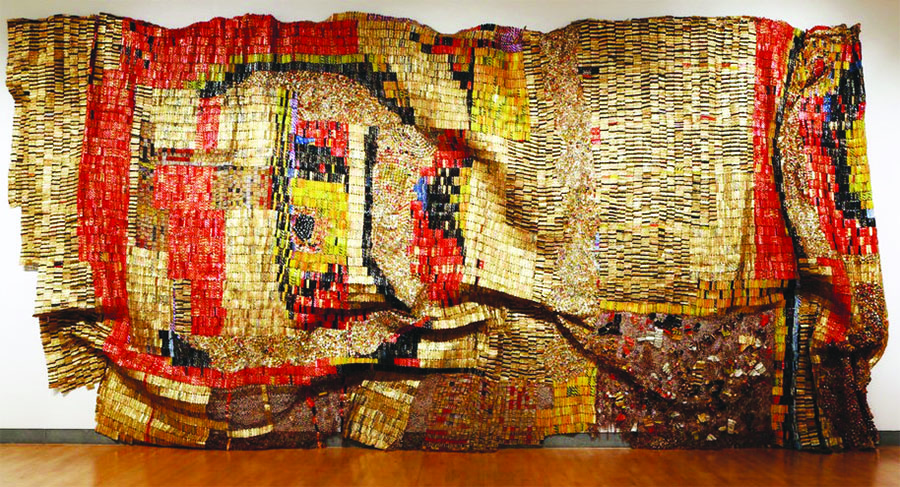
A powerful counterpoint is the work of El Anatsui. His monumental wall pieces, composed of thousands of flattened bottle caps and aluminium fragments, resist easy categorisation as ‘recycling’ art. Anatsui treats materials not as symbols of virtue, but as carriers of history: trade, consumption, colonialism, global exchange. The works are lavish, excessive, seductive. They do not resolve into neat environmental lessons. Their power lies precisely in the tension they sustain — between beauty and burden, materiality and meaning — keeping ethics and aesthetics, clarity and ambiguity, affirmation and critique in productive suspension.
This is what art does best when it is allowed to remain art. It can be socially engaged without losing its bite, think politically without collapsing into instruction. The challenge is not to retreat from environmental themes, but to create frameworks that leave room for artistic autonomy — for doubt, formal experimentation, and critical depth. When art is free to be unpredictable and open to multiple readings, it touches us more deeply and reshapes understanding more lastingly than direct campaigns ever could. That is when it truly serves both beauty and the urgent demands of our world.
• Dr Castellote is Director of the Yemisi Shyllon Museum of Art, Pan-Atlantic University














Leave a comment