



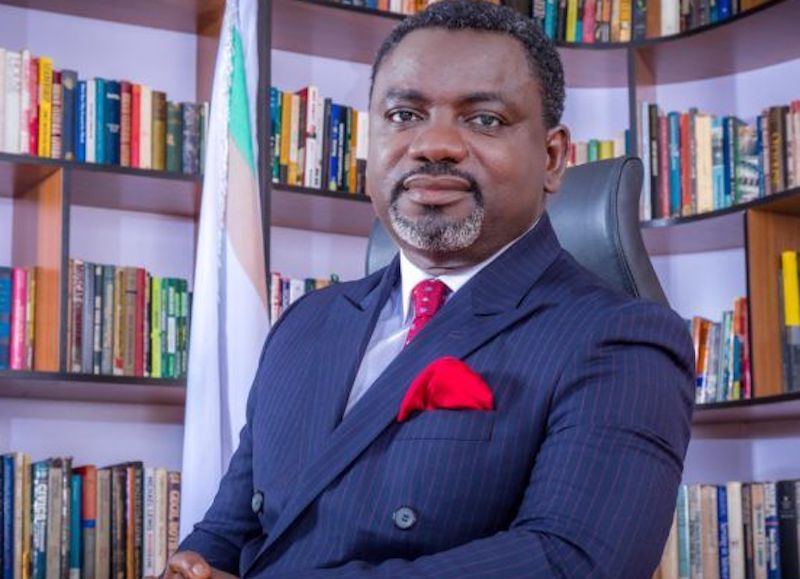
LINUS OKORIE contends that founders who leave legacies are those who built companies capable of becoming bigger without them
Paga just handed the keys to someone who wasn’t there at the start. If your company cannot do the same, you have built a ceiling.
Last week, Paga Group appointed Opeyemi Oyinloye as its new Group COO and CEO of Paga Nigeria, in an announcement titled “A New Era for Paga.” The detail most people glossed over is that Opeyemi joined Paga after a decade that Tayo Oviosu and Jay Alabraba founded the company. He was neither a co-founder, a family member, nor there at the beginning. And yet he is now the person entrusted with leading the most critical market in Paga’s portfolio.
Before we arrive at the lesson, let us establish the facts, because this kind of story is sometimes told as though success is simply a matter of loyalty and timing. Opeyemi came to Paga with a seasoned background in customer experience and operations, having previously served in multiple roles at Etisalat Nigeria, where he was recognised as the Best Customer Experience Champion.
At Paga, he started in customer experience and then expanded his remit steadily, moving from Head of Customer Experience to General Manager of Business Operations. In that role, he was accountable for scaling core infrastructure, redesigning customer-facing systems, and ensuring that the operational discipline of the company matched its ambitions. Tayo Oviosu himself offered this illustration: “If Paga were making sausages, Opeyemi was responsible for choosing which sausages to make and ensuring that whatever sausages were being made were made really well.”
There is a particular kind of founder arrogance that masquerades as dedication. They say things like “No one can run this business like I can. I know it better than anyone.” The conviction is usually sincere but equally dangerous.
What such a founder is actually building is a structure that requires their presence to function. This is a business wired so tightly around one person’s judgment, relationships, and energy that it cannot breathe without them. They mistake this dependency for indispensability. But what they have built is a ceiling. And the brutally honest question every founder must eventually answer is, if I disappeared tomorrow, would this company have a future?
Many founders, when they finally reckon with that question, default to finding their replacement elsewhere. Someone from a bigger company, with impressive credentials, who brings “fresh energy” and a pedigree that signals competence. It sounds logical. But the evidence disagrees, rather forcefully.
Research by Wharton management professor Matthew Bidwell found that external hires receive significantly lower performance evaluations for their first two years on the job compared to internal candidates promoted into similar roles. They are paid roughly 18 to 20 percent more, and yet they deliver less, at least initially. More tellingly, they are 61 percent more likely to be terminated than their internally promoted counterparts. Bidwell’s argument is that institutional knowledge cannot be transferred in an onboarding document.
The broader data points in the same direction. According to Russell Reynolds Associates, two-thirds of top executives in major companies are internal hires. In 2023, 74 percent of incoming S&P 500 CEOs had grown from within. Cornell University research published in Organisation Science found that the highest-performing internal hires were the most likely to stay, while the highest-performing external hires were among the most likely to leave. The conclusion is not that external hires are always wrong. It is that they are evidence of a company that did not invest deeply enough in developing its own people, and is now paying a premium to compensate for that gap.
The most instructive recent case study on this question is Nike. In 2020, the company appointed John Donahoe as CEO. He came from ServiceNow and eBay, with a strong track record and compelling credentials. On paper, the appointment made sense. In practice, what followed was a cautionary tale that business schools will study for years.
Under Donahoe’s leadership, Nike’s connection with athletes, independent retailers, and the wider sports community steadily eroded. His strategies did not align with the cultural DNA of the brand. The company cut too deep into its wholesale relationships and alienated the ecosystem that had made Nike great. By late 2024, he was removed.
He was replaced by Elliott Hill, a 32-year Nike veteran who had joined the company as an apparel sales intern in 1988, risen through the ranks across Europe and North America, and retired as President of Consumer and Marketplace in 2020. He was brought back specifically because he understood the factors that contributes to Nike’s global market share. In fact, Nike’s board stated that his “understanding of the industry and partners, paired with his passion for sport” made him “the right person to lead Nike’s next stage of growth.”
Since Hill’s return, the appointments have spoken a clear institutional language. His new COO, Venkatesh Alagirisamy, is a nearly 20-year Nike veteran. His newly appointed President of the Nike brand, Amy Montagne, has been with the company for two decades. The lesson for every Nigerian business leader is that organisations that nurture leaders from within perform better.
The reason most succession stories are painful is that founders treat succession as something that happens to them, rather than something they architect from the beginning. They only start thinking about it when they are exhausted, when investors apply pressure, or when health forces the conversation. By then, the company has already grown around them like concrete, and extracting the founder without cracking the structure becomes nearly impossible.
Paga’s story suggests a different architecture. Opeyemi was not parked in a corner with a polished title and a limited mandate. He was given the room to run the Nigeria operation as though it were already his, long before it formally became so. This distinction matters enormously. Many Nigerian founders complain that their employees do not develop an ownership mentality, that they lack intrapreneurship and initiative. What they rarely examine is whether they have created the environment in which that ownership can actually grow. You cannot confine a leader in a small room and then be surprised that they have not developed the wingspan for larger spaces. The enabling environment is not a reward for those who have already arrived. It is the very condition that produces arrival.
There is also a harder conversation that must be had about culture. Too many succession decisions in Nigerian companies are driven by sentiment like tenure, family membership, loyalty, or gender assumptions. What is needed instead is a culture where competence and performance determine advancement, and where leaders make the decision early that the institution must be capable of outliving them. That decision must be woven into how people are hired, how they are stretched, how they are evaluated, and how they are trusted with weight over time.
The context surrounding Paga’s transition makes it even more instructive. In 2025, the company processed ₦17.1 trillion in transaction value; a 96 percent increase year on year. It launched US banking services for the African diaspora through a partnership with Regent Bank, and became PayPal’s local partner in Nigeria. They are not handing over the keys at a moment of crisis. They are restructuring deliberately, from a position of strength. And Tayo is stepping up, taking on the Group CEO role as Paga has grown large enough that its Nigeria operation now needs its own dedicated leader, and it already had the right one inside.
Opeyemi’s appointment is proof that founders do not need to identify their successors on day one. But they do need to build a company where the right person, whenever they arrive, can be recognised, developed, and entrusted with increasing weight. That is the actual work. Many companies make different choices. Some keep their best people intentionally small, afraid that if those people grow too large, they will leave or, worse, begin to threaten the founder’s authority. Others promote on the basis of loyalty and tenure, confusing familiarity with competence. The result is a succession that looks safe from the outside but is fragile at its core, because the new leader was selected to preserve the past rather than lead the future.
A legacy-driven leader asks, what does this company need in its next era, and who, among all the people currently inside it, is most equipped to deliver that? Not who has been here the longest. Not who is most comfortable to the founder. But who has been forged by the work, shaped by the culture, and grown in the direction the company must now travel.
Companies that do not invest in growing their own leaders in the good times will be forced to find them elsewhere in the hard times, and they will pay twice for the privilege, once in premium salaries, and again in the cost of institutional knowledge that no external hire can fully recover.
Every founder will eventually leave. Voluntarily or not, in full health or otherwise, by design or by circumstance. The only variable is what state the company is in when that moment arrives. The founders who leave legacies are those who built companies capable of becoming bigger without them. Who developed leaders who went on to lead. Who created institutions that proved, by their continued existence and growth. The job of a leader is to build the business and the people who will carry it further. Tayo Oviosu understood this. Do you?
Okorie MFR is a leadership development expert spanning 30 years in the research,
teaching and coaching of leadership in Africa and across the world. He is the CEO of the
GOTNI Leadership Centre.












Leave a comment