



Jess Castellote
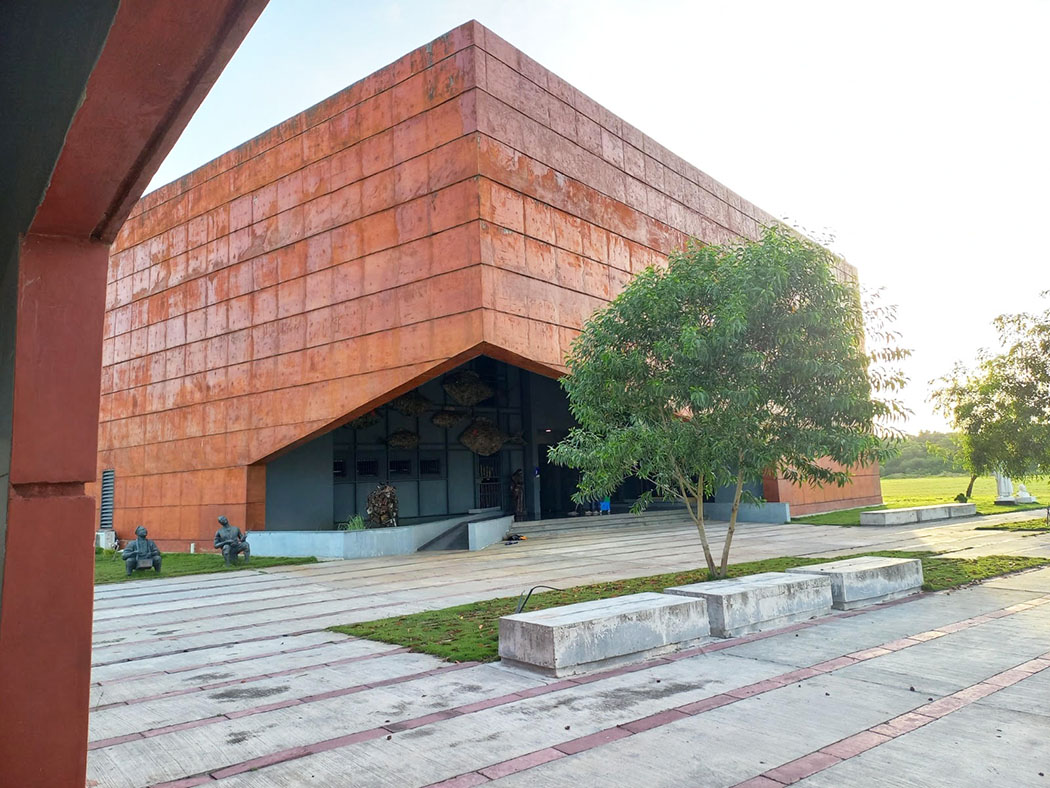
In recent decades, the category of spectacle has become a near-default way of describing the public life of art. Exhibitions promise immersive experiences; works are designed to be photographed and shared; attention, rather than contemplation, has become the measure of success. Those of us working in a museum navigate this tension every day. We need to attract visitors in an artworld that counts its value in attendance figures, shares and likes. The pressure to draw larger crowds tilts naturally toward immediacy: impressive displays, event-like exhibitions, experiences designed to grip quickly and reward the smartphone camera. Yet institutions tied to universities — like the Yemisi Shyllon Museum of Art at Pan-Atlantic University — or sustained by a public mission, still have the possibility of a different path. We can give works space to breathe, offer interpretation that guides without overwhelming, and allow for silence and slow looking. We need not reject bold gestures or genuine delight before a work of art. We need only remember that astonishment and patience can coexist, and that the deepest responses to art often require both.
This brings to mind Roger Scruton’s book Culture Counts, in which he argues that high culture is sustained by practices of judgment, discrimination, and transmission all of which presuppose patience, learning, and a reverence for form. Against this background, spectacle looks less like a neutral mode of presentation and more like a symptom of cultural decline. Scruton’s defence of beauty is also a defence of time. Beauty, as he sees it, calls the viewer to linger, to return, to allow meaning to unfold gradually. Spectacle, by contrast, is consumable: it satisfies instantly and exhausts itself just as quickly, treating viewers as restless and distractible rather than as people capable of real attention and judgment. The cultural danger is not that art becomes popular, but that it abandons the ambition to mean anything beyond the moment of impact. Works designed primarily to shock or provoke rarely outlast the context that produced them. Once the controversy fades, little remains. Spectacle accelerates cultural amnesia, replacing heritage with novelty and memory with sensation.
I have written before about the importance of silence in the experience of the visual arts. A painting, or a wall of colour, or a single fall of light can hold the attention so completely that plans, worries, even time itself recede. It happens only in front of great works, but it does happen. Anyone who has stood for some time before Velázquez’s Las Meninas in the Prado, or any of Rembrandt’s self-portraits scattered through the museums of Europe, or spent time before one of Bellini’s Madonnas at the Galleria dell’Accademia in Venice, knows exactly what I mean. But there is no need to travel so far. Close to home, we also have works of extraordinary beauty, meaning and quality. When we approach them, we may enter the room expecting intellectual interest. But, if we give them time, something in us may be quietly rearranged by the time we leave.
For decades, a strand of criticism has regarded such moments with suspicion. If beauty or sheer presence overwhelms, the viewer is said to have surrendered too readily, seduced into passivity, complicit in spectacle rather than engaged in critique. The warning, traceable to Guy Debord’s The Society of the Spectacle (1967), is familiar: deep feeling risks manipulation; genuine response should keep its distance. I do not find that view convincing. The most enduring works of art have frequently been spectacular. The Sistine ceiling was painted to inundate the senses until the divine felt almost tangible. The great rose windows of Gothic cathedrals do not invite detachment but awe and a lifting of the heart. Rothko’s dark fields rarely prompt analysis at first sight; they ask for stillness.
And the Obalufon bronze mask in our museum astonishes every visitor who comes before it. Astonishment is not a flaw in these experiences. It may be among the truest forms of contact that art can offer.
The difficulty arises when spectacle is asked to carry what meaning and beauty alone should bear. When size, shock or instant visibility substitutes for substance. We have all seen exhibitions that dazzle briefly and vanish, leaving no trace beyond the photograph taken in the moment. The error, though, would be to conclude that spectacle itself must be refused. The remedy is not its absence but its refinement: art that commands attention because it has earned it through integrity and depth. The finest works may be restrained and quiet, yet they stop you in your tracks. That quietness is spectacular in the highest sense — arresting, indelible, resistant to haste.
Roger Scruton argued that authentic beauty invites lingering and return, that it unfolds across time rather than consuming itself in a single impact. Others have cautioned that when a work depends on the viewer’s presence and reaction to complete its effect, it edges toward theatricality and away from the self-contained life of art. This is a recognition of a shared loss: the replacement of patient encounter with consumable experience. When every exhibition must be spectacular, shareable, and instantly gripping, a quieter, more enduring relation to art can slip away. Yet the opposing risk is equally serious: an art culture so wary of beauty and aesthetic pleasure, so determined to avoid being moved, that it cancels the very reason most people seek art in the first place. We do not enter galleries principally to remain guarded and to practice an intellectual exercise. We enter in hope that something may reach and touch us.
A subtler danger appears when spectacle drifts into pure entertainment. Entertainment, in its proper sphere, is honest and valuable: it sets out to divert, amuse, and provide genuine pleasure. But art has always served a far wider range of purposes. It has confronted uncomfortable truths and also decorated spaces with harmony and beauty. It has aided devotion and opened pathways to the transcendent. It has told stories that bind communities across generations and offered consolation in grief. When artworks — or the exhibitions that frame them — are shaped primarily to entertain, that rich multiplicity narrows into a single, thinner function. Difficulty, ambiguity, even quietness come to be treated as failures rather than possibilities.
Once art is reduced to reliable entertainment, it slides toward commodity. It must compete in the same economy of attention as streaming series and viral videos. Value is measured by dwell time, ticket numbers, social-media reach. The object itself becomes secondary to the experience sold around it. What endures is no longer what a work means across decades but how efficiently it produces a momentary high, and depth gives way to novelty.
Many museums are no longer neutral containers of art but active producers of experience: they design narratives, choreograph movement, manage attention, and compete for visibility within a crowded cultural marketplace. The pressure to attract audiences and justify public or philanthropic funding has encouraged exhibition-making that privileges immediacy, immersion and eventfulness. In this context, the temptation of spectacle is structural, not merely ideological. At the YSMA, we would like to achieve a genuine balance — avoiding both the cold elitism that speaks only to the initiated and the shallow entertainment that asks nothing beyond a passing thrill. The ideal is accessibility without simplification, and depth without exclusion. Beauty has a quiet but essential role to play here: not as a decorative lure or a forbidden pleasure, but as the quality that draws us in and holds us, making the encounter with art approachable without ceasing to be profound. At a university museum such as ours, that balance must be both a goal and a daily practice — welcoming every visitor while trusting them with works that repay patient looking.
The distinction that matters is not between spectacle and seriousness but between spectacle that serves meaning and spectacle that displaces it and dissolves into entertainment and commodity. At its finest, art achieves both: it draws the viewer into its world while remaining sufficient unto itself. It meets us where we stand, and yet continues beyond our looking. Great art has always known how to arrest us. If we can learn once more to honour that arrest rather than hurry past it, we may rediscover why the encounter was ever worth seeking.
If it relinquishes that role entirely, it risks becoming indistinguishable from other sites of cultural consumption. If it holds on to it, even selectively, it preserves the possibility that art can still be more than an event, that it can endure, resist, and continue to matter beyond the moment in which it is seen.
• Castellote, PhD, is the director, Yemisi Shyllon Museum of Art. Pan-Atlantic University















Leave a comment