



Sunday Ehigiator
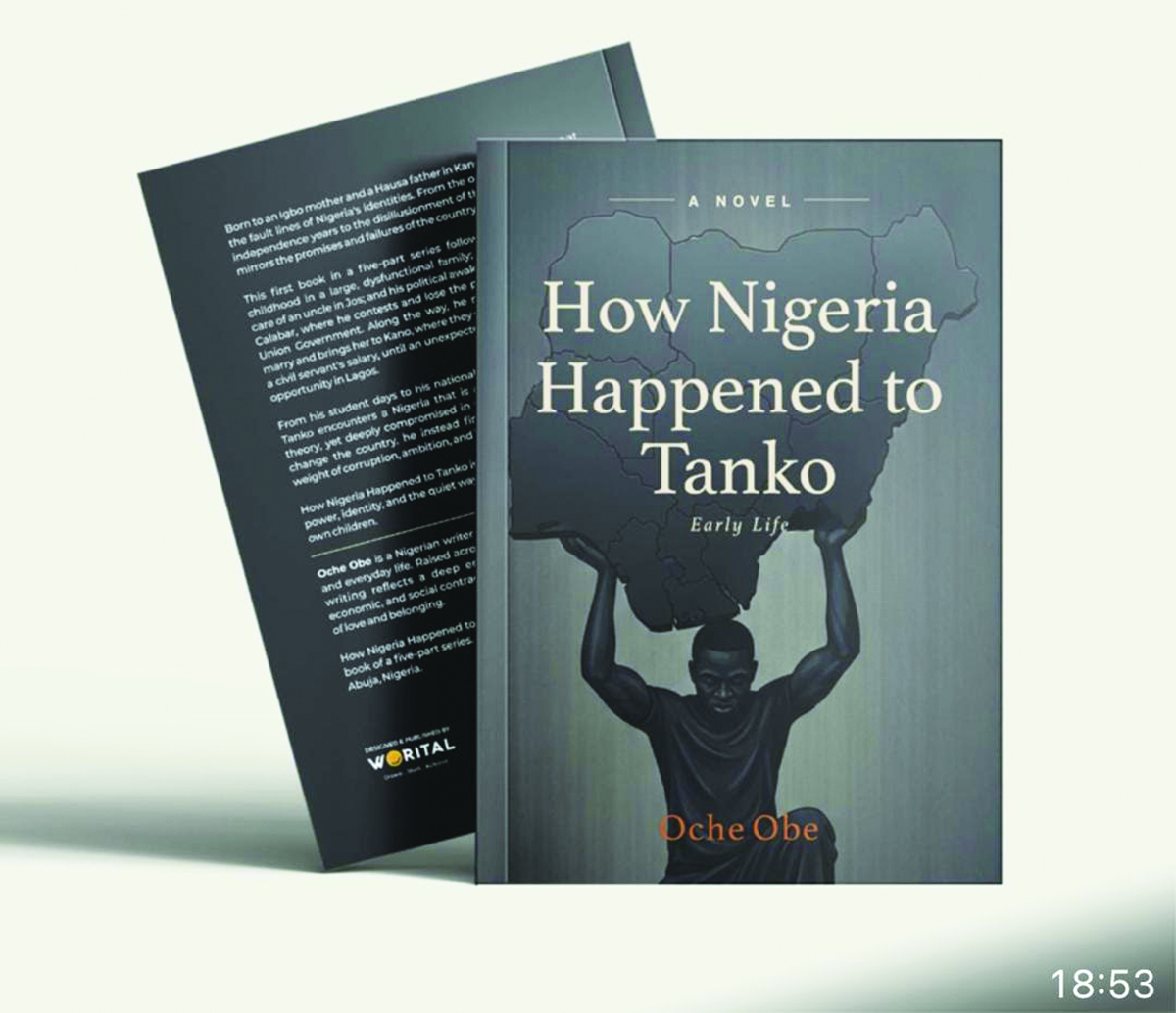
Obe’s decision to mark his birthday with the virtual launch of his debut novel went beyond celebration. It was a deliberate and reflective statement about storytelling, memory, and the enduring question of what it means to belong in Nigeria. The online event, moderated by development consultant Ben Ariko, unfolded with intimacy, bringing together friends, colleagues, and literary enthusiasts who engaged critically with the ideas at the heart of the work.
“This is really a privilege, because of our friend who is celebrating his birthday and has decided that this birthday must be unique,” Ariko noted in his opening remarks. What emerged was not just a book launch, but the introduction of a narrative that situates itself within the enduring tradition of Nigerian literature, one that interrogates identity, nationhood, and lived experience.
At the centre of the novel is Tanko, a young boy born into the intersection of Hausa and Igbo identities. From the outset, his life is framed not simply as a coming-of-age story, but as a journey through a terrain shaped by history, prejudice, and expectation.
Obe describes the story as both reimagined and deeply personal. “This story is part of a creative reimagining of the life my friend and schoolmate would have lived,” he said. “It developed over a long time. I desired to tell a very true story that feels real and relatable.”
Yet beyond its personal roots, the novel expands into a broader reflection on the Nigerian experience. It raises enduring questions: Where do I belong? Who am I? How much of identity is inherited, and how much is shaped by environment?
“The book is about identity. It is about belonging. It’s about conflict, both within and around us,” Obe explained. “Beyond Tanko as an individual, this is a story about Nigeria.”
Rather than leaning on dramatic plotlines or overt political commentary, Obe adopts a measured narrative style. He turns to the quiet rhythms of everyday life—family interactions, childhood experiences, and moments of self-discovery.
This restraint gives the novel its strength. Tanko is not constructed as a symbol or ideological device, but as a boy trying to understand his world. Through his experiences, deeper societal fault lines, ethnic identity, cultural expectation, and the search for acceptance—emerge naturally.
A reviewer at the launch described the book as “a slice of life captured in a well-wrought canvas,” highlighting its exploration of identity, ambition, and resilience against the Nigerian backdrop.
One of the novel’s most compelling elements is its treatment of identity as fluid and evolving. Tanko’s dual heritage places him in an ambiguous space, belonging fully to neither side, yet shaped by both.
Discussant Emmanuel Abah captured this dynamic succinctly: “Nigeria happened to Tanko in many ways, from religion to cultural difference to ethnic discrimination. These are things that could happen to anybody.”
Another contributor, Gabriel, pointed to moments of possibility within the narrative: “There is a need for integration, and if we make a conscious effort, people can actually be integrated.”
Through such reflections, the novel moves beyond personal struggle to suggest a broader, if cautious, optimism about coexistence.
Central to Tanko’s journey is the family, the first space where identity is shaped and contested. In Obe’s narrative, the home is not merely a backdrop but an active force.
Tanko’s upbringing unfolds within a complex household marked by polygamy, competing maternal influences, and the absence of his biological mother. Affection is uneven, authority fragmented, and belonging often conditional.
These dynamics mirror the wider Nigerian experience. The divisions within the household, cultural, emotional, and hierarchical, echo the fault lines of the nation itself. Yet moments of warmth and connection also exist, suggesting the possibility of unity despite tension.
Through this layered portrayal, the family becomes a microcosm of Nigeria: diverse, complex, and constantly negotiating differences.
A defining moment in the novel comes with its opening line: “Nigeria happened to Tanko for the first time when he was just nine years old.” The passage, set during a chaotic Independence Day celebration, introduces what one participant at the launch described as the “anyhowness” of Nigeria.
“The ‘anyhowness’ has stayed with us,” remarked Sonny Anyang. “It’s a graphic way of bringing out how things are done in Nigeria.”
Within the narrative, this concept is not presented as an overt critique but as a lived reality. It emerges through everyday encounters where systems lack structure and predictability, forcing individuals to adapt.
For Tanko, these experiences are formative. They shape his understanding of authority, fairness, and survival. Yet the novel resists reducing this condition to negativity alone. Within the same unpredictability, moments of resilience, humour, and connection emerge.
In this way, “anyhowness” becomes both a critique and a lens, capturing the complexity of Nigerian life without oversimplification.
Obe’s prose is marked by deliberate simplicity. The language is clear, direct, and accessible, making the novel approachable to a wide audience.
Beneath this simplicity, however, lies depth. The prose does not draw attention to itself but serves as a transparent vehicle for the story. Emotional and thematic layers emerge organically, allowing readers to engage directly with Tanko’s experiences.
The pacing is measured, reflecting lived experience rather than dramatic urgency. Identity and belonging unfold gradually, reinforcing the novel’s thematic focus on growth and self-discovery.
Within the broader context of Nigerian literature, the work aligns with a longstanding tradition of exploring the relationship between individual and nation. Rather than offering a sweeping account, Obe narrows his focus to one life, using specificity to illuminate broader truths.
As one reviewer observed, the narrative “tracks how a nation leaves its mark on its citizens, and how their collective actions in turn shape its evolution.”
As the first instalment in what appears to be a larger narrative, How Nigeria Happened to Tanko: Early Life lays a reflective foundation. It introduces themes of identity, belonging, conflict, and resilience without resolving them, allowing them to remain open for further exploration.
Obe resists neat conclusions. Instead, he presents identity as an ongoing process, shaped by time and experience.
“Ultimately, my story is not about defeat,” he said in his closing remarks. “It is a story of becoming, of living in Nigeria.”
That sense of becoming defines the novel’s lasting impact. Tanko’s journey remains unfinished, shaped by contradictions, clarity, and uncertainty.
In telling the story of one boy with honesty and restraint, Obe creates space for a broader reflection. Readers are invited not just to follow Tanko’s life, but to see fragments of their own within it, to consider their own questions of identity and belonging within Nigeria’s complex and evolving landscape.














Leave a comment