



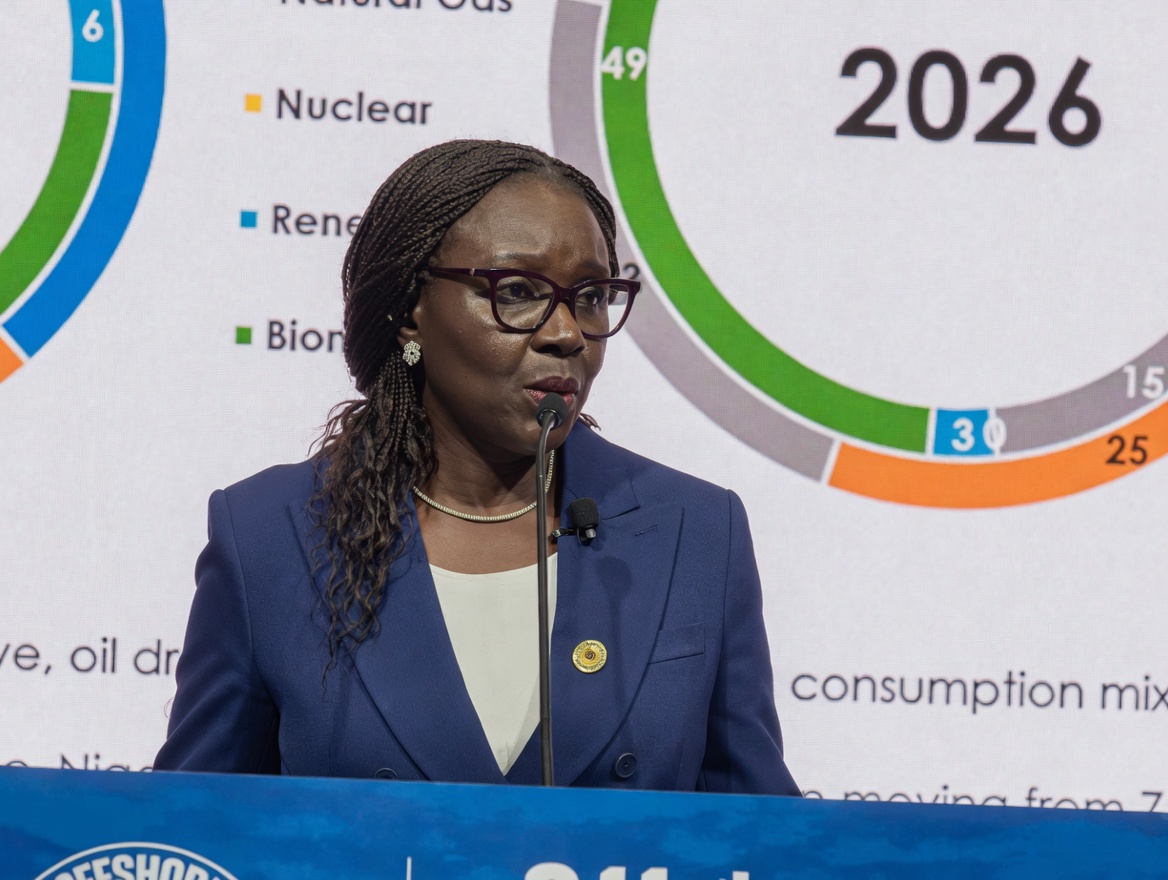
The Commission Chief Executive of the Nigerian Upstream Petroleum Regulatory Commission (NUPRC), Mrs Eyesan Oritsemeyiwa, has said about 10 million barrels of oil have been taken off the global market by ongoing geopolitical tensions in the Middle East.
The NUPRC boss spoke at the 10th Africa Energy Summit, themed “Scaling Innovation, Financing and Industrial Capacity for Africa’s Energy Security”, at the ongoing Offshore Technology Conference (OTC) in Houston, Texas.
Oritsemeyiwa said the supply disruption had created a significant deficit, reversing earlier market conditions in which supply outpaced demand.
According to her, the development has heightened global concerns over energy security, as countries scramble for alternative sources to make up for the shortfall.
“The removal of about 10 million barrels from the market has created a supply gap, and the key question now is where that deficit will be filled from,” she said.
She explained that traditional oil-producing regions are grappling with declining output, limiting their ability to respond effectively to the disruption.
In contrast, she said Africa is increasingly emerging as a viable answer, driven by new discoveries and untapped reserves across the continent.
Oritsemeyiwa said Africa holds about 225 billion barrels of oil and some 625 trillion cubic feet of gas, representing around 10 per cent of global reserves.
She stressed that unlocking these resources would depend on sustained reforms and investment-friendly policies across African countries.
In Nigeria, she pointed to the Petroleum Industry Act (PIA), enacted in 2021, as a major milestone that has repositioned the country’s oil and gas sector.
The law, she said, has introduced fiscal clarity, enhanced regulatory efficiency and improved transparency, helping to restore investor confidence.
Following years of declining upstream investment from about $15 billion annually to less than $7 billion, she said Nigeria is now witnessing a rebound, with several major projects reaching final investment decisions.
She added that the NUPRC approved 48 field development plans in the past year, while recent licensing rounds offering about 50 oil blocks attracted nearly 300 expressions of interest from investors.
Despite the renewed momentum, Oritsemeyiwa identified infrastructure gaps, particularly in gas development, as a major constraint.
She noted that Nigeria, which accounts for about 215 trillion cubic feet of Africa’s gas reserves, is investing in pipeline infrastructure to boost domestic supply and support regional energy needs.
The Nigerian National Petroleum Company Limited (NNPC Ltd.), she said, is advancing key gas pipeline projects aimed at linking production hubs in the Niger Delta to broader markets.
She further emphasised that Africa’s growing population and industrialisation drive make it imperative to harness its vast energy resources.
Oritsemeyiwa also disclosed that African regulators are strengthening collaboration through a continental platform aimed at improving the investment climate and removing barriers to growth.
She urged global investors to seize emerging opportunities across the continent.
“Africa is open for business. The resources are abundant, and the regulatory frameworks are improving to support sustainable investment,” she said.















Leave a comment