



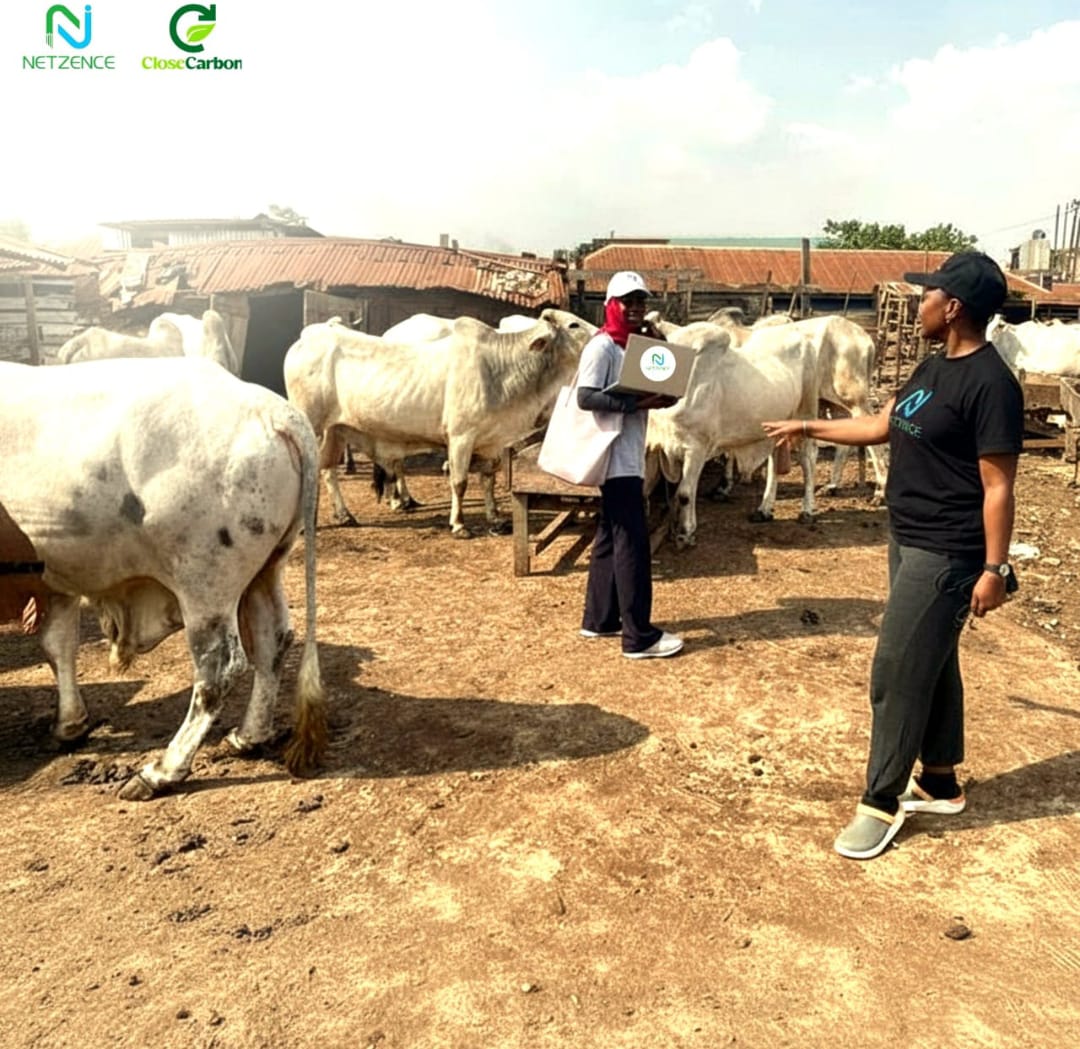
Netzence Sustainability Limited, Netzence, in partnership with 3logy Limited and the Federal Ministry of Livestock Development (FMLD) has disclosed that there is a measurable seasonal and regional differences in methane emissions within Nigerian livestock systems.
In animals, primarily ruminant livestock like cattle and sheep, methane emissions refer to the release of methane gas produced during a natural digestive process.
According to a preliminary field data emerging from an ongoing national monitoring programme led by the three organisations, early results indicate that livestock facilities monitored in Nigeria’s North-Central zone showed higher methane-linked greenhouse gas emissions compared to the South-West.
This research aligns with international research, which shows that livestock systems operating under hotter, more extensive, and open-grazing on average produced 10.82 per cent higher enteric methane emissions than semi-intensive or better-buffered systems.
According to Associate Professor Sadiq Sani, Founder and Chief Executive Officer of Netzence, the variations observed in the current dataset fall within the scientifically established ranges, even within the relatively short monitoring window covered so far.
A statement from Netzence reads: “What distinguishes this programme is that it does not stop at identifying variation; it begins to explain it. The data reveals clear structural contrasts between the two regions. In the South-West, livestock production is dominated by semi-intensive and intensive systems, with herds comprising a higher proportion of young and mid-age animals, approximately 79.62 per cent, alongside low to moderate daily movement. In contrast, North-Central systems are largely extensive and agro-pastoral, characterised by higher daily mobility and a greater share of mature animals, estimated at 54.87 per cent of herd composition. From an emissions standpoint, mature cattle and sheep have larger rumen volumes and higher feed intake, resulting in greater baseline enteric methane output per head. This structural difference directly explains the higher emission intensity and variability observed in North-Central readings.
“Animal size further reinforces this trend. The dataset shows that cattle in South-West systems typically averaged a weight of 289.6 kilograms, compared to an average of 305 kilograms in North-Central herds. Sheep weights follow a similar pattern, averaging 37.5 kilograms in the South-West and 39.8 kilograms in the North-Central zone. Larger animals produce higher absolute methane emissions, and when this is combined with open-field exposure and extended grazing hours, measurable emission spikes emerge, particularly during periods of high activity and thermal stress.
“Feeding systems also play a decisive role. In the South-West, livestock diets rely more heavily on cultivated pasture, legumes and crop by-products, resulting in relatively stable digestibility across seasons. North-Central herds, by contrast, depend largely on natural pasture and crop residues, with pronounced seasonal variability especially during dry periods. Lower-digestibility diets are known to increase methane yield per unit of intake, resulting in irregular emission curves and short-term spikes during periods of forage scarcity or prolonged grazing. These mechanisms are consistent with the higher variability recorded by Netzence embedded technologies in North-Central locations.
“Environmental exposure compounds these effects. The monitoring programme indicates limited housing and shade availability in many North-Central systems, compared with greater environmental buffering in South-West operations. Prolonged exposure to open environments elevates respiration rates, water intake and metabolic stress, all of which amplify enteric methane signals, particularly during peak daytime heat. This explains the temporal spikes detected in the dataset and underscores that the variations observed are physiological and system-driven, not anomalies.
“As part of an ongoing programme to establish regional methane emission baselines for livestock systems in Nigeria, monitoring was conducted across selected sites in the South-West and North-Central zones during the December–January period, which coincides with Harmattan conditions. At this stage, long-term baselines have not yet been finalised; however, early datasets allow for comparison against emerging average conditions observed within each system.
Quoting Associate Professor Sadiq Sani, the statement said: “During this period, methane measurements indicated temporary spikes above the prevailing average range in both regions, with more pronounced variability observed in North-Central livestock systems. These deviations aligned with seasonal factors typical of the Harmattan, including reduced pasture quality, dry atmospheric conditions, and increased grazing duration, particularly in extensive production systems. Scientific literature consistently shows that such conditions influence rumen fermentation efficiency and can increase methane yield per unit of intake, especially in mature animals and open-grazing systems.”
The statement further said: “Livestock systems in the South-West which are generally more semi-intensive and environmentally buffered, exhibited lower-amplitude deviations and faster return toward average conditions, reflecting greater feed stability and reduced exposure to seasonal stressors. These regional differences are consistent with an established understanding of how production systems respond to dry-season environmental pressure.
“From a production perspective, these observed methane deviations are interpreted as indicators of seasonal system stress rather than abnormal emission behaviour. Dry-season nutritional constraints and environmental exposure are widely associated with reduced feed efficiency and increased energy losses through methane production, which can impact overall system performance.
“In response, Netzence, in collaboration with FMLD, is using these observations to support evidence-based baseline development and management planning, which will include improved dry-season feed strategies, heat-stress mitigation measures, and refinement of monitoring protocols. As data collection continues across a full annual cycle, these seasonal signals will contribute to the development of robust, region-specific methane baselines that can support future mitigation planning, inventory improvement, and climate policy implementation.
“These findings represent a sharp departure from how livestock methane has traditionally been handled in national climate planning. Historically, Nigeria has relied on imported default emission factors that assume uniformity across continents and production systems. Such averages obscure the diversity of Nigeria’s livestock practices and environmental conditions. By embedding Netzence technologies directly within pastoral, semi-intensive, intensive and transhumant sheep and cattle systems, the current programme replaces conjecture with continuous, verifiable evidence.
Netzence monitoring technologies deployed sample methane concentrations alongside temperature, humidity, and airflow, transmitting readings in real time to its CloseCarbon platform. Recorded emissions are supported by internationally accepted models. In practical terms, methane concentrations in the air around animals are measured alongside activity and environmental data and automatically converted into auditable emissions profiles that evolve. To ensure reliability, all readings undergo rigorous quality-control validation, including real-time plausibility checks against expected emission ranges for animals based on weight, cross-sensor consistency verification during spike events, and meteorological alignment to confirm that observed variations correspond with environmental exposure.
The implications extend well beyond reporting. Without credible baselines, emission reductions cannot be demonstrated, climate finance cannot flow at scale, and policy interventions risk missing their targets. By generating country-specific, measurement-based data, the programme strengthens Nigeria’s capacity to advance toward higher-tier Greenhouse Gas (GHG) reporting, improve the credibility of its national inventories and prepare the livestock sector for participation in emerging methane-focused carbon markets, where verified reductions increasingly command premium value.”













Leave a comment