



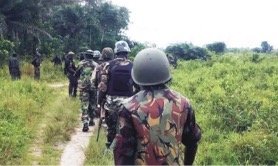
The Armed Forces of Nigeria and other security agencies have remained resolute in the battle against oil theft in the Niger Delta, sustaining operations to safeguard critical national assets despite resistance from some host communities and the complexities of the terrain, writes Linus Aleke
Nigeria’s history is closely intertwined with the hydrocarbon wealth of the Niger Delta. Crude oil has long served as the backbone of the national economy, accounting for more than 90 per cent of revenues accruing to the national treasury and remaining the country’s largest source of foreign exchange. Sustained oil production is therefore central to national development. Yet, the same resource has also been a source of environmental degradation and social tension.
Recurrent oil spills have damaged fragile ecosystems, polluted rivers and creeks, and disrupted traditional livelihoods such as fishing. Over time, agitation over resource control and the impact of oil exploration has fuelled militancy, piracy, sea robbery, kidnapping for ransom and widespread crude oil theft.
To confront these challenges, the military, acting on presidential directives, established a joint security architecture in the region under the Joint Task Force South-South, codenamed Operation Delta Safe (OPDS). Coordinated by Defence Headquarters, the operation integrates land, maritime and air components in a multi-agency framework that includes the Armed Forces, the Nigeria Police Force, intelligence agencies and other paramilitary organisations.
Currently led by Rear Admiral Olugbenga Oladipo Operation Delta Safe continues to drive efforts aimed at curbing oil theft and related crimes. Supporting him are component commanders responsible for land, maritime and air operations across the theatre.
Providing insight into recent developments, the Land Component Commander of OPDS and General Officer Commanding (GOC), 6 Division, Nigerian Army, Port Harcourt, Major General Eric Emekah, said sustained military pressure on pipeline vandalism has significantly improved crude oil production.
During a media tour of the operation’s area of responsibility in Port Harcourt, Emekah noted that enhanced security has enabled national output to rebound to approximately 2.2 million barrels per day.
He linked this improvement to the reduction of violent pipeline vandalism and other forms of economic sabotage.
“The Niger Delta remains the backbone of Nigeria’s economy, and the performance of the oil and gas sector is a critical indicator of our operational effectiveness,” he said.
According to him, since assuming command on January 24, 2025, Operation Delta Safe has not recorded any incident of violent pipeline vandalism within its area of responsibility. He recalled that prior to this period, production fluctuated between 1.4 and 1.5 million barrels per day, but rose steadily following a presidential directive to increase output, reaching about 2.2 million barrels per day by December 2025.
Emekah added that from January 2025 to date, no oil company in the area has reported pipeline breaches linked to vandalism. Where leaks occurred, investigations attributed them largely to ageing infrastructure rather than deliberate interference, with affected companies promptly notified for remedial action.
On illegal refining, he explained that many operations were traced to abandoned oil wells rather than active pipelines. He said intensified patrols, sustained follow-up operations and the disruption of logistics and market networks have weakened the activities of illegal refiners.
Central to these gains, he emphasised, is continuous engagement with host communities. Regular dialogue with community leaders and mediation between oil companies and local stakeholders have helped address grievances and reduce tensions, thereby restoring economic activities such as fishing in many riverine areas. While the land forces project confidence, operational realities remain demanding.
Earlier, the Commander of OPDS, Rear Admiral Olugbenga Oladipo, highlighted the difficulty of securing thousands of wellheads scattered across swampy and densely forested terrain.
He noted that in some instances, community members even employ local spiritual means to discourage oil companies from accessing facilities.
“In many areas, thick vegetation makes movement almost impossible. Even when illegal activities are detected, access remains a serious constraint,” he said, adding that despite these hurdles, troops conduct at least two major operations daily in addition to routine patrols.
A recent example of sustained pressure is the reclamation of the Adibawa Oil Well from crude oil thieves. Following a series of coordinated operations, the Joint Task Force announced that the well had been secured. Arrangements have since been concluded with Reconizer Oil Company to establish a 24-hour surveillance post to prevent a resurgence of illegal bunkering.
Speaking at the wellhead, the Acting Garrison Commander of 16 Brigade, Nigerian Army, Yenagoa, Major Hassan Mubarak Mohammed, said the success resulted from persistent patrols and anti-bunkering missions. He pointed to remnants of an illegal refining camp near the facility, describing how criminals had previously tapped crude directly from the source.
Although the swampy terrain poses significant challenges, he said troops maintained pressure until the perpetrators retreated deeper into the forest. The strategy, he explained, has shifted from temporary raids to permanent deployment, with plans for amphibious operations during the rainy season using houseboats and gunboats to maintain year-round control.
Despite these operational gains, pushback from some communities continues to complicate efforts, particularly for the Air Component. The Air Component Commander of OPDS and Commander of the 115 Special Operations Group, Group Captain Abdulafeez Opaleye, expressed concern over frequent litigation arising from air interdiction missions.
Addressing defence correspondents, Opaleye described community resistance and limited cooperation as major constraints. He noted that in some instances, air strikes targeting illegal refining sites located near legitimate businesses have led to court actions against the Nigerian Air Force over alleged collateral damage.
“The greatest challenge we face is the unwillingness of some communities to disengage from crude oil theft and other criminal activities,” he said.
He cited cases in which air operations near illegal refining sites allegedly affected facilities such as alcohol distilleries and palm oil production centres, prompting legal claims.
According to him, damages that could otherwise be resolved amicably are sometimes escalated into prolonged litigation, complicating operational planning and execution.
Beyond community-related issues, he also warned that oil theft syndicates have become increasingly organised and adaptive.
“Criminality in the Niger Delta is no longer crude or isolated,” Opaleye said, explaining that operators now siphon crude through hoses extending several kilometres into concealed locations within communities, employing coordinated and carefully timed methods to evade detection.
Even so, military authorities insist that the guiding objective remains the protection of national oil output. With crude production rebounding and a target of three million barrels per day set for 2027, Operation Delta Safe continues to balance sustained enforcement with community engagement, navigating a complex environment where economic survival, environmental realities and national security intersect.















Leave a comment